About the work
Johann Wolfgang von Goethe's one-act Singspiel was composed in 1779/80 after his second Swiss journey and was premiered in 1780 at the Weimar Amateur Theatre. The work is set in a Swiss alpine valley and combines pastoral idyll with an unusually direct love story. It was set to music by Philipp Christoph Kayser (1780), Johann Friedrich Reichardt, and later Adalbert Gyrowetz.
Plot
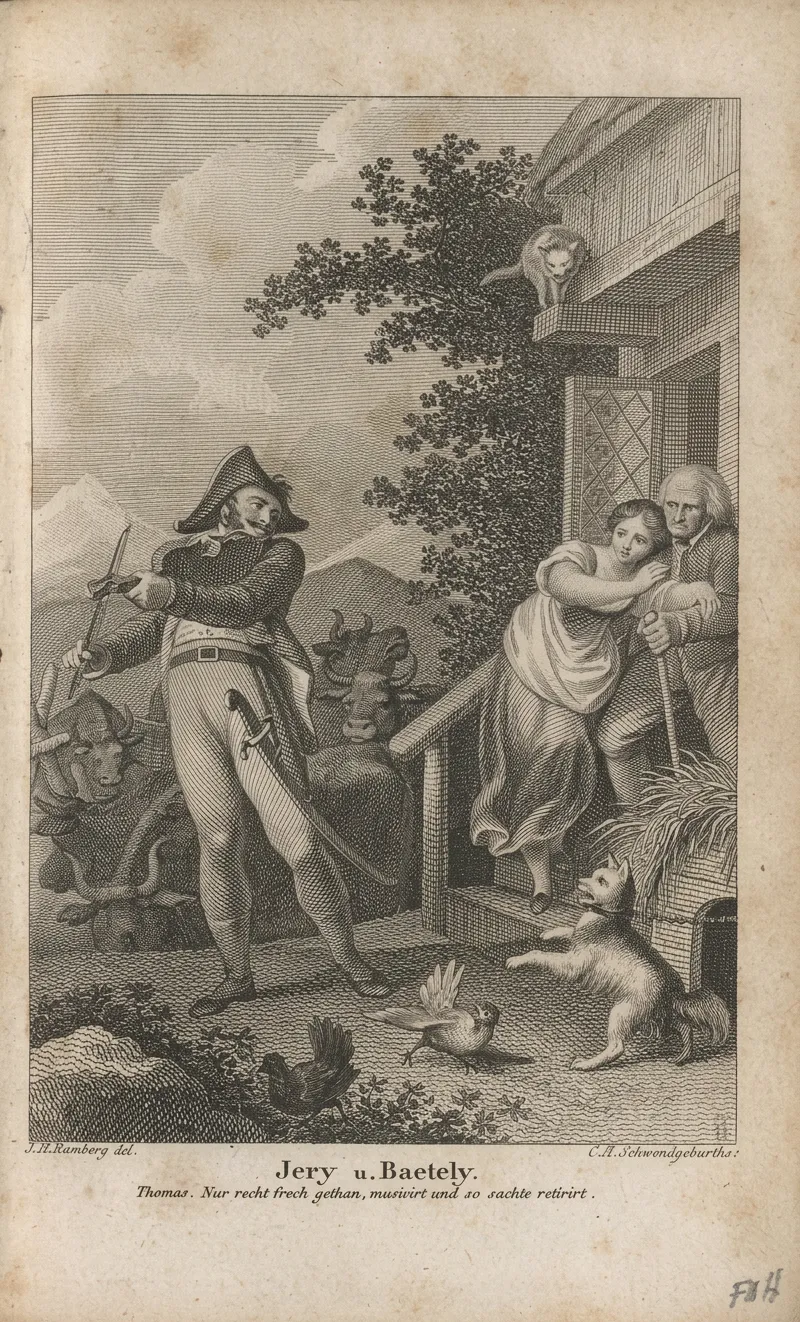
The young Bätely lives alone with her father on a Swiss alpine pasture. Her beloved Jery, a shy young mountain farmer, does not dare to ask for her hand. When the soldier Thomas arrives and courts and presses Bätely with crude passion, Jery must choose between cowardice and intervention. Jery's courage saves Bätely, she becomes engaged to him, and Thomas reveals himself at the end as Jery's old schoolfriend, who had staged the situation to move his timid friend to confess.
Cultural significance
Jery und Bätely is among Goethe's most musically successful Singspiele and established the Swiss idyll as a genre motif on the German-language stage. Gyrowetz's 1803 setting remained in the repertoire of court theatres for decades. The work remains a valued resource for opera and drama academies because of its compact cast and the psychologically subtle triangular constellation.