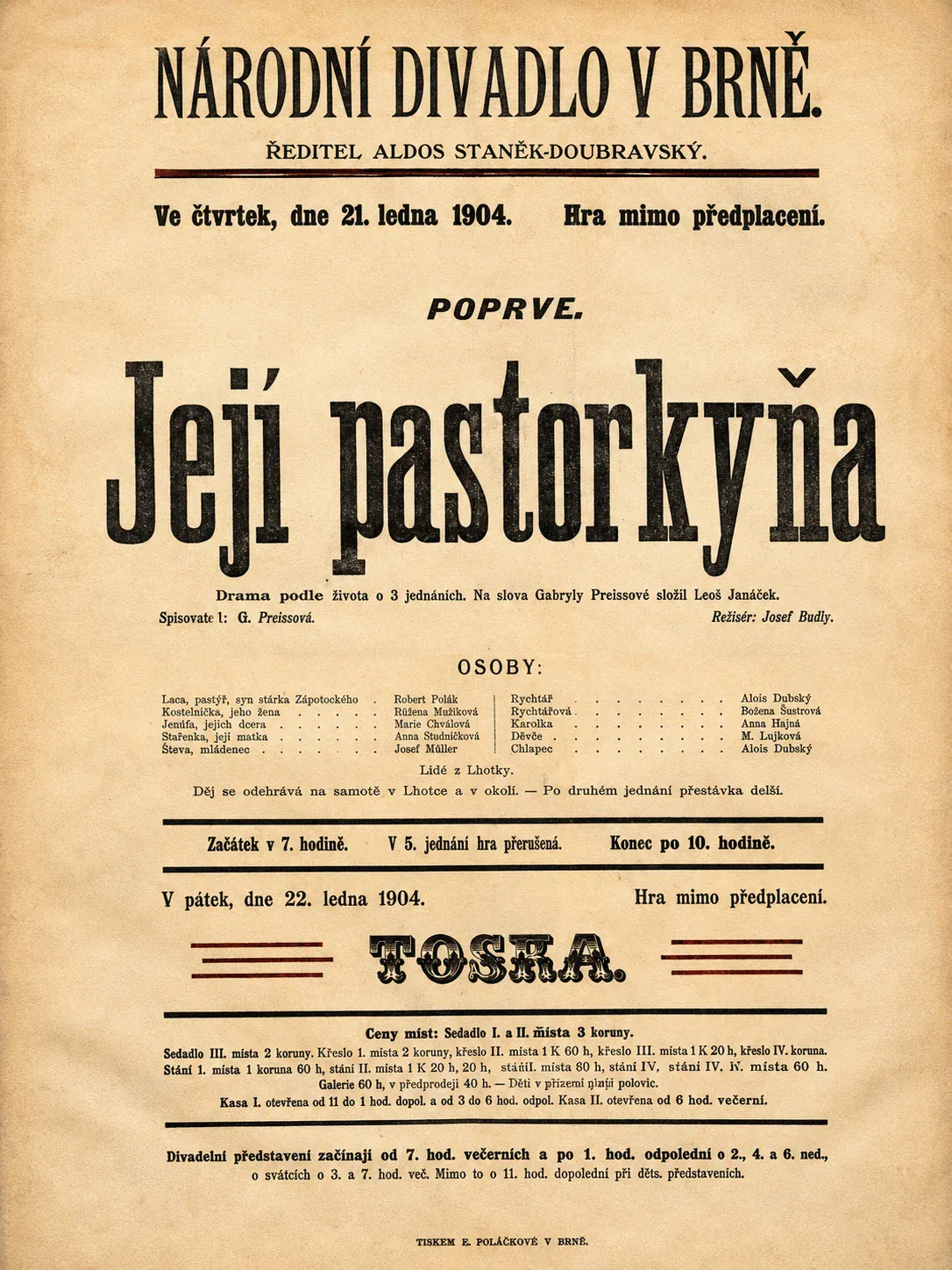
About the work
Leoš Janáček's three-act opera was premiered in 1904 at the Národní divadlo Brno and reached international recognition only through its Vienna premiere in 1918, when Janáček was already sixty-four. The Czech libretto is the composer's adaptation of Gabriela Preissová's play Její pastorkyňa (Her Stepdaughter), set among the peasant community of Moravia. The work launched Janáček's late creative explosion.
Plot
The young village woman Jenůfa, pregnant out of wedlock, is abandoned by the charming Števa and comforted by his half-brother Laca—who, in a moment of jealous rage, cuts her face. Jenůfa's stern stepmother Kostelnička, the village's sexton-keeper, hides her shame through the winter. When the baby is born, Kostelnička, desperate to protect Jenůfa's future, drowns the child in the icy river. In spring, as Jenůfa is about to marry Laca, villagers discover the body. Kostelnička confesses publicly and is led away. Jenůfa, in the supreme moment of the opera, forgives her stepmother and turns fully to Laca, who has loved her through everything.
Cultural significance
Jenůfa established Janáček's distinctive style: melodic lines derived directly from Czech speech inflection, a highly compressed orchestral vocabulary, and dramatic scenes of extraordinary psychological truth. The opera has become the most-performed Czech opera worldwide, with landmark productions by David Pountney (Welsh National Opera) and Claus Guth (Bayerische Staatsoper). The role of Kostelnička is among the most fearsome mezzo or soprano parts in the repertoire, demanding vocal strength and absolute dramatic commitment.