About the work
Johann Wolfgang von Goethe's „Iphigenie auf Tauris" was written in two versions — a first prose version in 1779 and the definitive verse version in 1786-87 in Italy. The play was premiered in Weimar in 1779 with Goethe himself as Orestes. It is regarded as one of the purest works of German Classicism and of the humanity-idea.
Plot
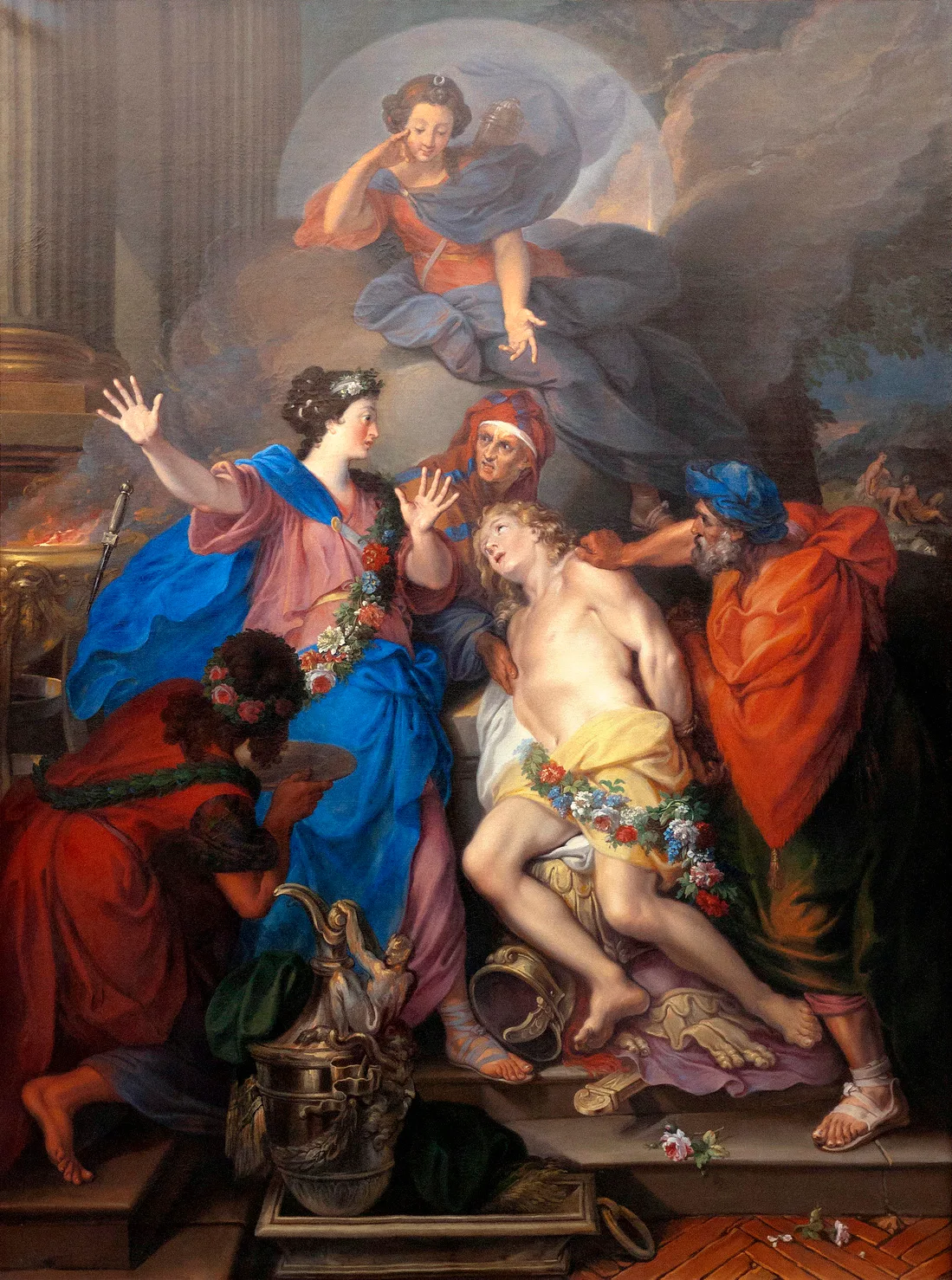
On the island of Tauris (today Crimea) lives Iphigenia, years earlier rescued by the goddess Diana from being sacrificed by her father Agamemnon and transported to Diana's temple. She serves as priestess and has weaned King Thoas from the old duty of sacrificing every arriving stranger. Thoas, whom Iphigenia has refused as a wife, choosing against his love, now threatens to reintroduce the old custom. At that moment two strangers come ashore — Iphigenia's brother Orestes and his friend Pylades. Orestes is hunted by Furies for having killed Clytemnestra (his mother) to avenge Agamemnon. In the temple the siblings recognise each other. Pylades plans escape: Orestes is to seize the Diana image with Iphigenia's help (Apollo's oracle). Iphigenia wrestles between her duty to truth and her family love — and decides to tell Thoas the truth. She appeals to his humanity. Thoas, moved, lets the three depart — „Farewell!" The cleansing of Orestes from family guilt happens through Iphigenia's truth and Thoas's forgiveness — not through ritual.
Cultural significance
Iphigenie auf Tauris is Goethe's most classical work and a formative source for the German idea of humanism. The famous lines „seeking the land of the Greeks with the soul" and „All human frailties / are atoned by pure humanity" shaped educated Germany of the nineteenth and early twentieth century. Continuously in the German repertoire; productions range from Reinhardt to Marthaler, Karin Beier, Stephan Kimmig. Gluck's opera „Iphigénie en Tauride" (1779, based on Euripides — not Goethe) is a separate tradition.