About the work
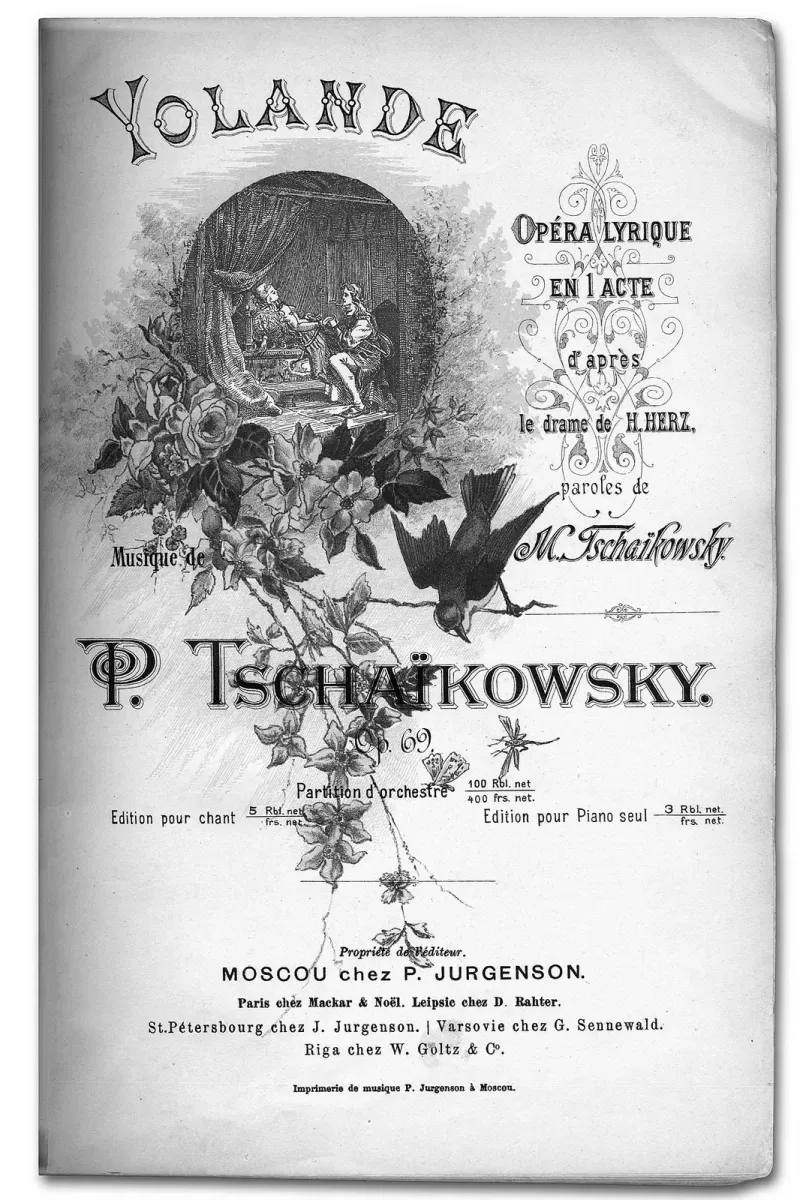
Pyotr Ilyich Tchaikovsky's one-act lyric opera, his final operatic work, was premiered on 18 December 1892 at the Mariinsky Theatre Saint Petersburg in a double bill with the premiere of The Nutcracker ballet. The libretto by the composer's brother Modest Tchaikovsky is based on Henrik Hertz's Danish drama Kong Renés datter and dramatises the tender story of a blind medieval princess who does not know she cannot see.
Plot
In a sealed garden in Provence, the blind princess Iolanta has been raised without knowledge of her blindness—all those around her have been forbidden to mention sight. Her father King René has arranged her marriage to Duke Robert, who however loves another woman. Robert's companion Vaudémont enters the garden, falls in love with Iolanta, and inadvertently reveals to her that she cannot see. The devastating revelation precipitates a crisis, but the Moorish physician Ibn-Hakia insists that healing requires Iolanta's own conscious desire for sight. Her love for Vaudémont provides the necessary will; her sight is restored in a miraculous closing scene.
Cultural significance
Iolanta is among the tenderest of Russian operas and increasingly celebrated as a Tchaikovsky masterpiece, despite its long eclipse by the composer's earlier Onegin and Pique Dame. Iolanta's aria about her unknown longing, and the luminous final ensemble, are among Tchaikovsky's most radiant compositions. Peter Sellars's production at the Metropolitan Opera and Mariusz Treliński's Warsaw staging have reaffirmed the opera's place in contemporary repertoire. The role of Iolanta is a defining lyric soprano part, associated in recent decades with Anna Netrebko and Sonya Yoncheva.