About the work
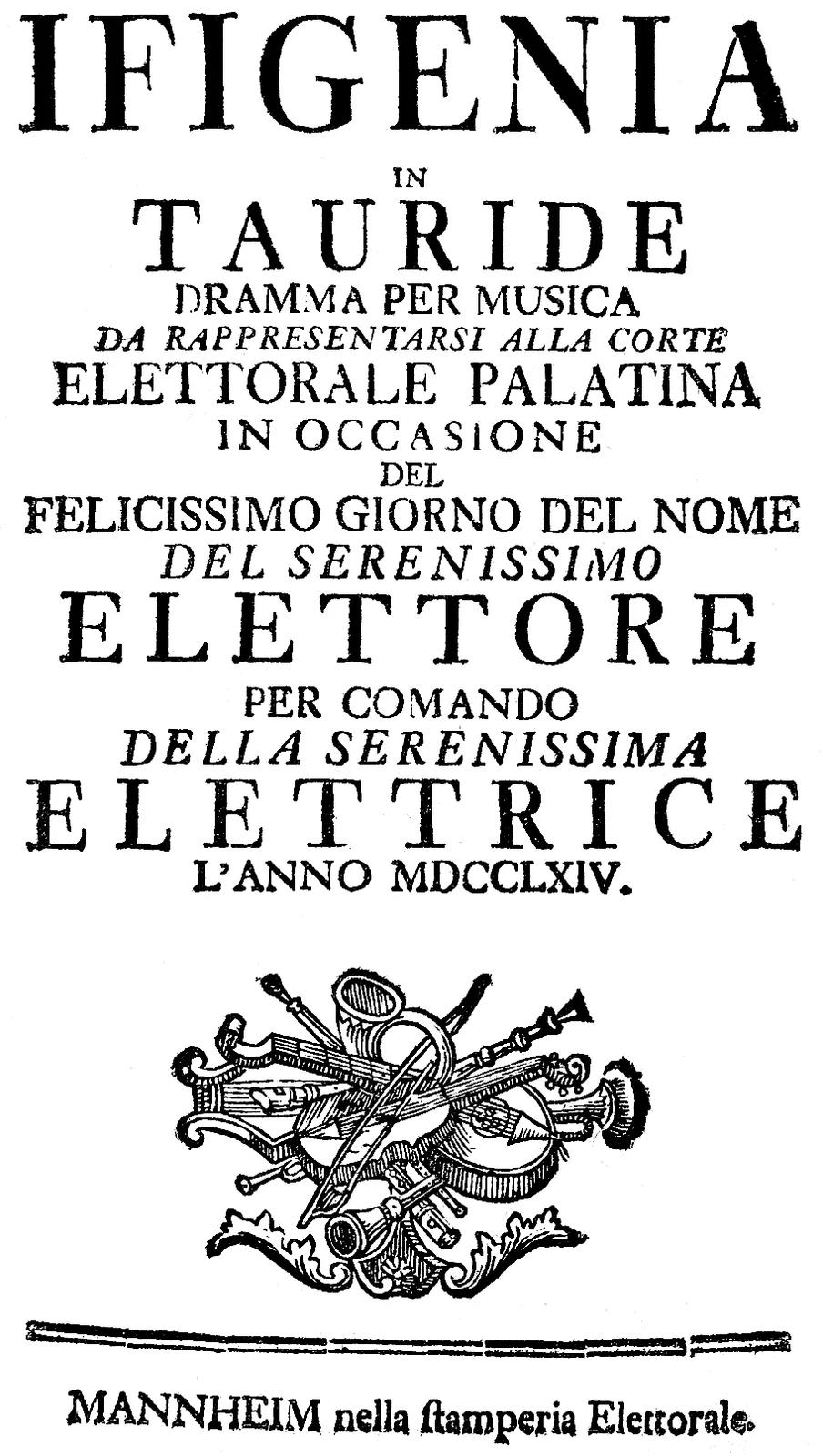
Ifigenia in Tauride is an opera in three acts by Gian Francesco de Majo to a libretto by Mattia Verazi, drawing on Euripides' tragedy and on Claude Guimond de La Touche's 1757 play Iphigénie en Tauride. Commissioned by the Elector Palatine Carl Theodor, it premiered on 5 November 1764 at the court theatre in Mannheim, then one of Europe's leading opera houses.
Plot
Iphigenia, priestess of Diana on Tauris, is ordered by the tyrant Thoas to sacrifice one of two captured Greeks and recognises one of them as her brother Orestes, whom she had believed dead. She devises a plan to save both prisoners and to carry off Diana's cult statue in order to break the curse weighing on Orestes; the opera ends with Thoas's death in a burning temple and the Greeks' escape.
Cultural significance
For the entrance of the character Merodate, de Majo used so-called 'Janissary music' in Mannheim, an exoticising sound then still unusual for a German audience. The writer Wilhelm Heinse later compared de Majo's setting with Niccolò Jommelli's treatment of the same subject. After long neglect, the work returned to the stage only in 1999, at the theatre in Heidelberg.