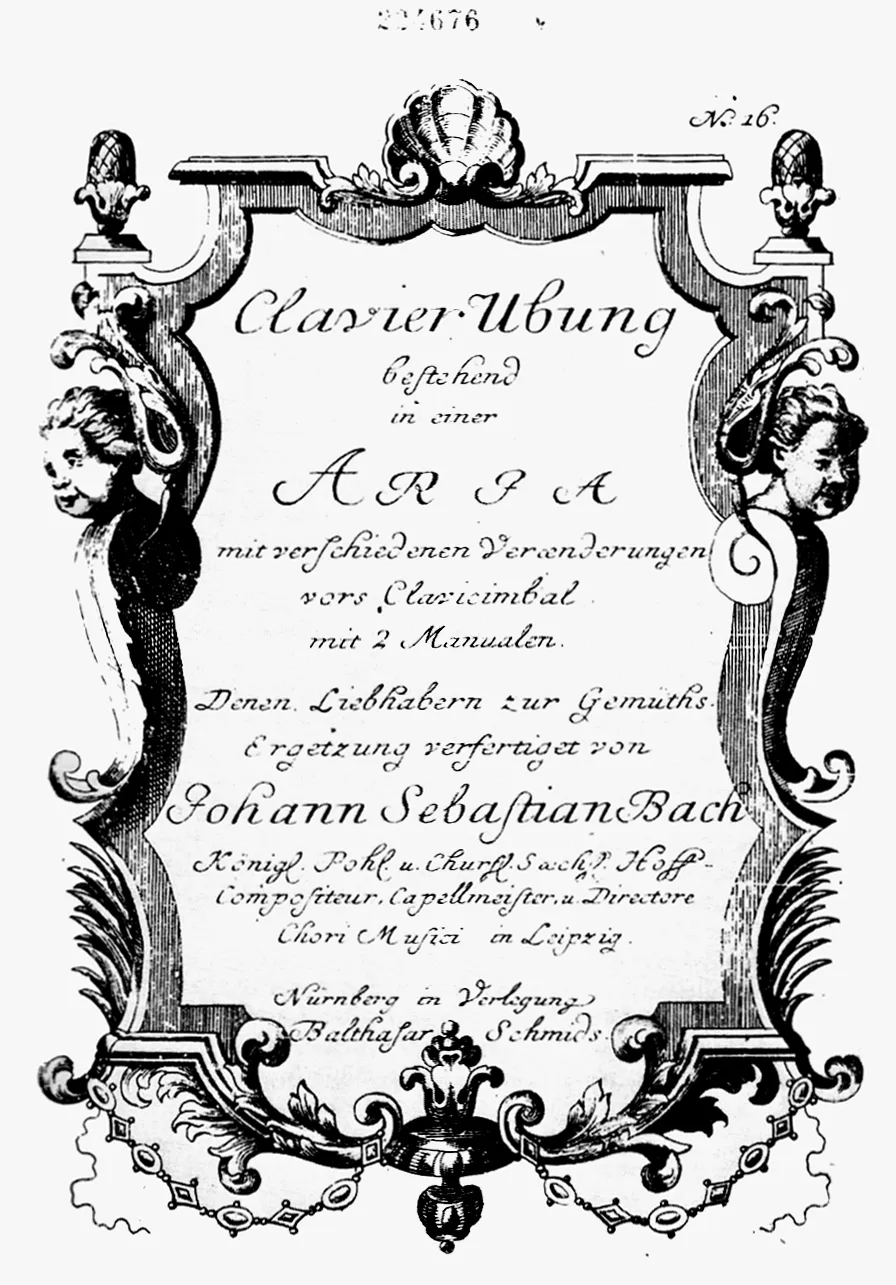
About the work
Johann Sebastian Bach's „Goldberg Variations" (BWV 988, published 1741 as part 4 of the „Clavier-Übung") rank among the greatest compositions for keyboard. The collection consists of an aria and 30 variations, framed by a repetition of the aria at the close — an architectural completeness without parallel.
Plot
A famous anecdote (recounted by Forkel in 1802, historically disputed) tells that Bach composed the variations for the insomniac Russian ambassador Count Keyserlingk, whose harpsichordist Johann Gottlieb Goldberg was to play them during his sleepless nights. The structural construction is overwhelming: the underlying aria — a simple 32-bar sarabande — returns in each of the 30 variations not as a melodic line but as the BASS line / harmonic scheme. Every third variation (3, 6, 9, 12 ...) is a canon, in rising intervals (canon at the unison, second, third, ... up to canon at the ninth). Variation 25 — the famous „Black Pearl" — is the emotional climax: a chromatically deep lament. Variation 30 is NOT a canon but a „Quodlibet" — a humorous interweaving of two folk songs („I have not been with you so long" and „Kraut und Rüben have driven me away"). At the close the aria returns unchanged — like a homecoming.
Cultural significance
The Goldberg Variations are one of the supreme compositional achievements in the history of music and became a cult work in the twentieth century through Glenn Gould's two recordings (1955 and 1981). Gould's 1955 debut recording, with which he became world famous, is considered one of the most influential classical recordings of all time. Other significant interpretations: Wanda Landowska (on historical harpsichord), Rosalyn Tureck, András Schiff, Murray Perahia, Pierre Hantaï, Beatrice Rana. Bach's original is written for a two-manual harpsichord — variations with crossed hands are extremely difficult on the piano.