About the work
Samuel Beckett's two-act play „Happy Days" was premiered in New York in 1961 — Beckett wrote it first in English, unlike his earlier French texts. The play is considered one of Beckett's most difficult and at the same time most poetic works and is a study of hope in absolute helplessness.
Plot
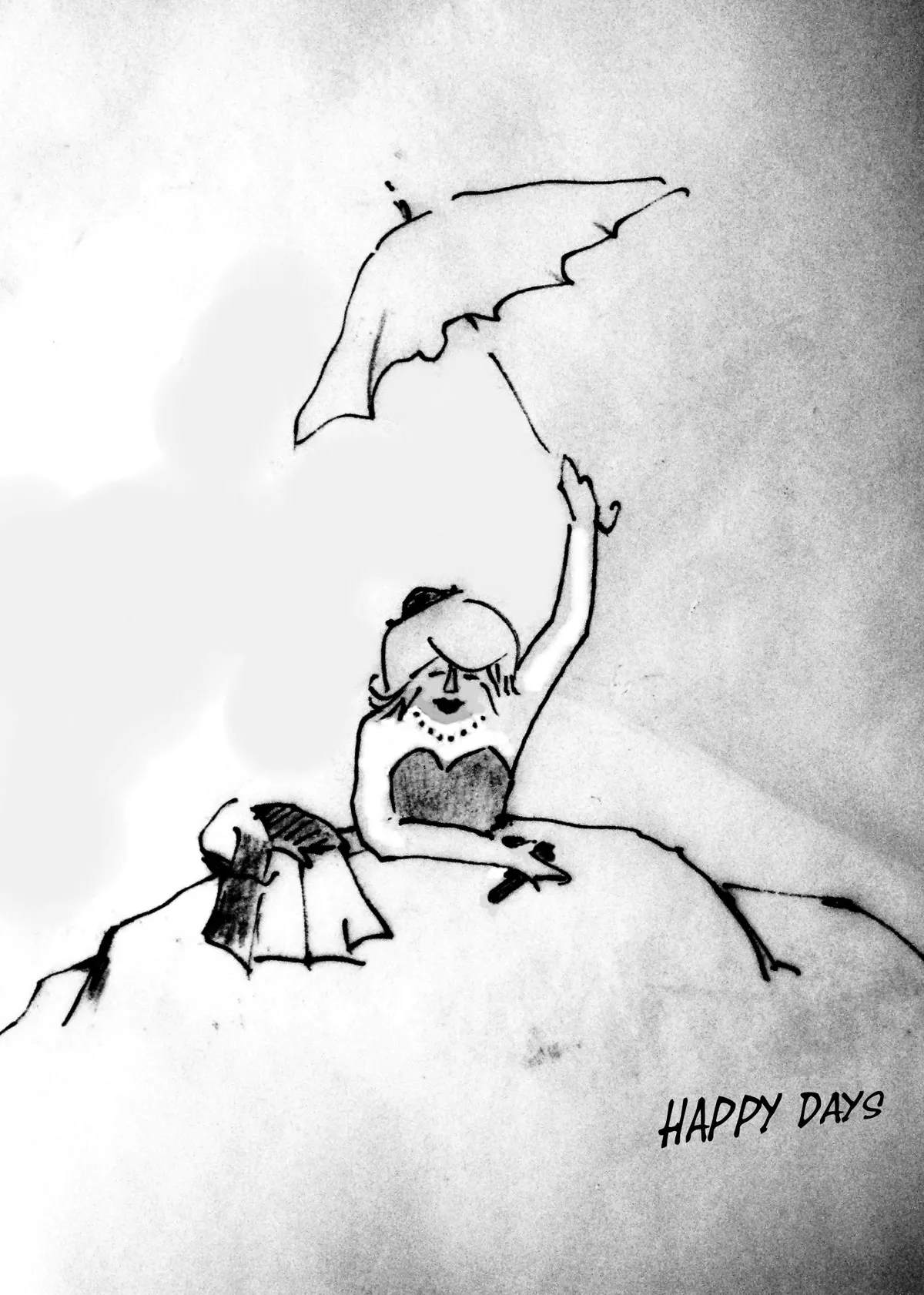
Act one: in the middle of a bare, sun-scorched mound of earth, Winnie, a woman of about fifty, is buried up to her waist. A shrill bell wakes her. Winnie ritually performs her day: toothbrush, spectacles, lipstick, hairbrush, all from a large black bag. She speaks ceaselessly — to her husband Willie, who lies behind the mound on the ground and scarcely responds. Winnie's sentences are phrases, memories, fragments of song, always pervaded by the question „What is the alternative?" Winnie is optimistic in an absurd situation; that is the joke of the play. She finds the day „happy" — because of every small thing that still works. Act two: Winnie is now buried up to her neck. She can no longer even move her head. The bell wakes her whenever she sleeps. She continues to speak, ever more fragmentarily. In the final image Willie crawls up to her — desperate, or with murderous intent? Beckett leaves it open. He does not quite reach Winnie's face. End: long pause, both look at each other. Curtain.
Cultural significance
Happy Days is, after Endgame, Beckett's most concentrated work and one of the most coveted solo plays for actresses — Winnie's role spans over two hours of monologue with minimal freedom of movement. Famous Winnies include Madeleine Renaud (Beckett's favourite Winnie, Paris 1963), Billie Whitelaw (Beckett's pupil), Fiona Shaw, Juliette Binoche (Vienna 2014), Heike Makatsch and Annette Paulmann on German stages. The staging condition — an actress half-buried in sand — makes the play the most extreme physical challenge in the repertoire.