About the work
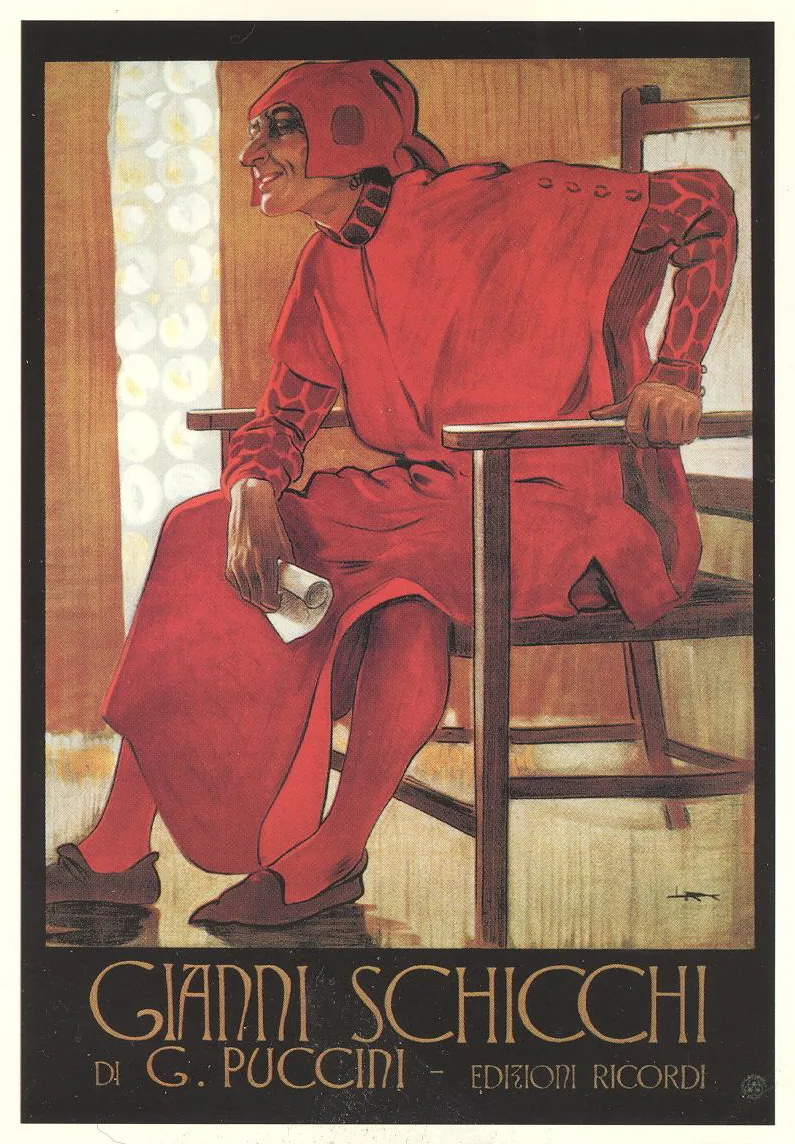
Giacomo Puccini's one-act comic opera forms the third part of his Il Trittico, three contrasting one-act operas premiered together on 14 December 1918 at the Metropolitan Opera New York. Based on a brief passage in Dante's Inferno, the work is Puccini's only mature comedy and has far outpaced its companion works Il Tabarro and Suor Angelica in popularity, often performed alone or paired with other short operas.
Plot
In thirteenth-century Florence, the wealthy Buoso Donati has died leaving his fortune to a monastery. The scandalised family, including the greedy Zita and her niece Lauretta, calls in the cunning commoner Gianni Schicchi to help them rewrite the will. Gianni agrees on condition that his daughter Lauretta may marry Rinuccio, the young man she loves. Gianni impersonates the dying Buoso before a notary, dictates a new will—and, to the family's horror, leaves the most valuable properties to himself. The Donati cannot object without revealing their own fraud. The young lovers sing the famous duet O mio babbino caro, and Gianni addresses the audience directly: if there was ever a better way to spend the money, speak now.
Cultural significance
Gianni Schicchi is Puccini's single perfect comic miniature and contains the soprano aria O mio babbino caro—one of the most famous and accessible pieces in all of opera, used in countless films and commercials. The title role is a signature baritone part, played by Tito Gobbi, Geraint Evans, and more recently Plácido Domingo in his baritone career. Productions of the complete Trittico have grown more frequent in recent decades, restoring Puccini's original vision of triptych contrast.