About the work
Jean-Paul Sartre's play „No Exit" („Huis clos") was premiered in Paris in 1944 — still under German occupation. The one-act play is considered the most important drama of French existentialism and contains Sartre's most famous line: „L'enfer, c'est les autres" („Hell is other people").
Plot
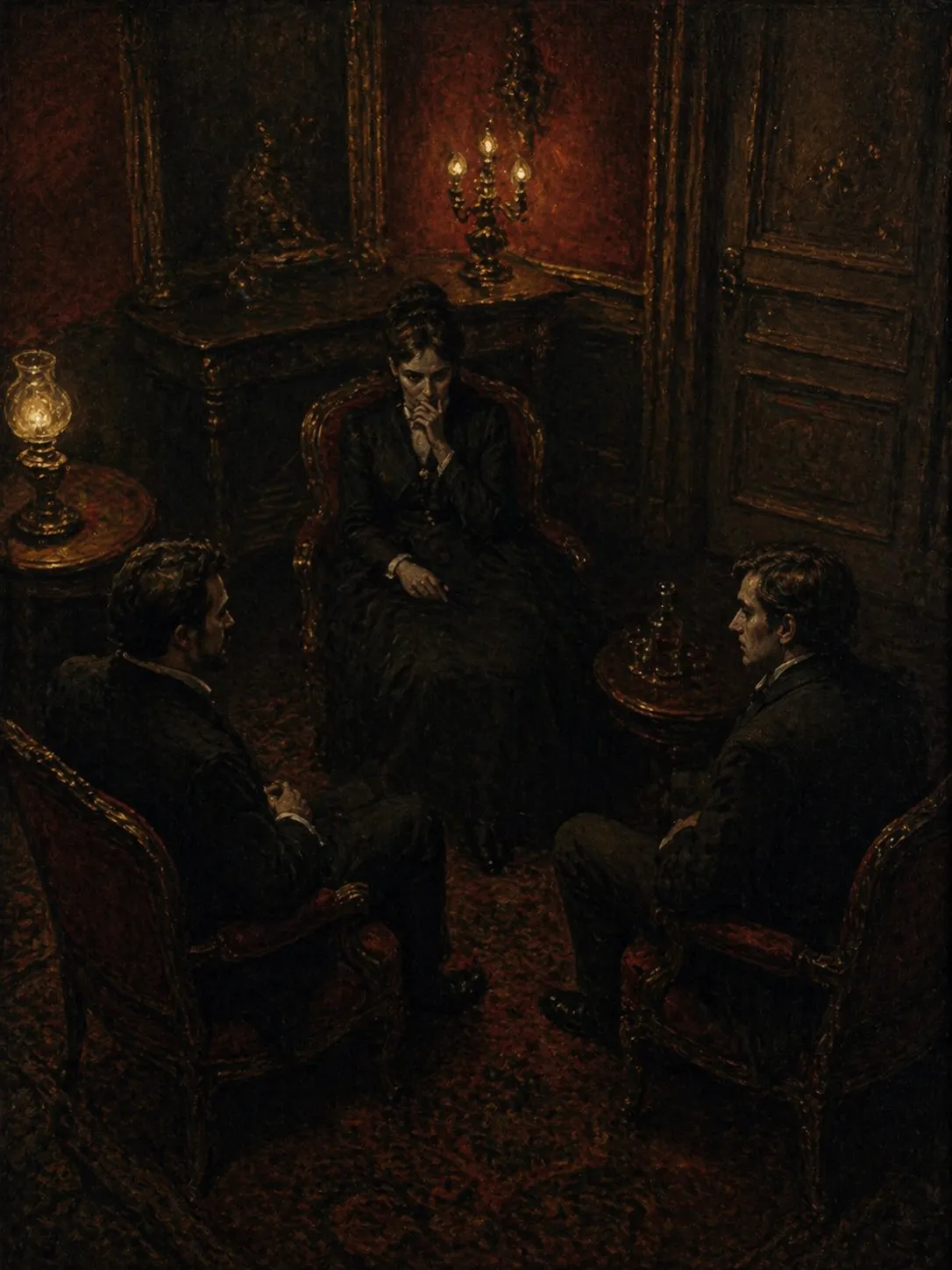
Three dead people — the deserter and pacifist Garcin, the lesbian Inès, the childishly cruel Estelle — are led by a valet into a hotel room in Second Empire style. They quickly realise: they are in hell. There is no torture, no demons, no flames — only the room, whose door will not open, no sleep, no death, no mirror. In the course of confrontation the three tell their backstories and recognise that they are together because each represents the ideal torture for the others: Inès desires Estelle, who needs men; Estelle desires Garcin, who seeks affirmation as a hero; Garcin needs a woman who does not see through him, but Inès sees through everything. Garcin's life story (he had himself shot trying to flee as a deserter) is brutally exposed by Inès as cowardice. At the moment when Garcin resolves to love, the door springs open — but no one goes. The room is no longer prison but self-chosen hell. „Eh bien, continuons." — Well, let us go on.
Cultural significance
No Exit is Sartre's most-performed play and a key text of post-war existentialism. The idea that hell consists in the inescapable entanglement with other consciousnesses became a philosophical formula. Productions range from the 1944 Paris premiere — directed by Sartre himself, still under German occupation — through stagings by Patrice Chéreau, Krzysztof Warlikowski and Karin Henkel. The play is standard repertoire on German stages and a popular school text.