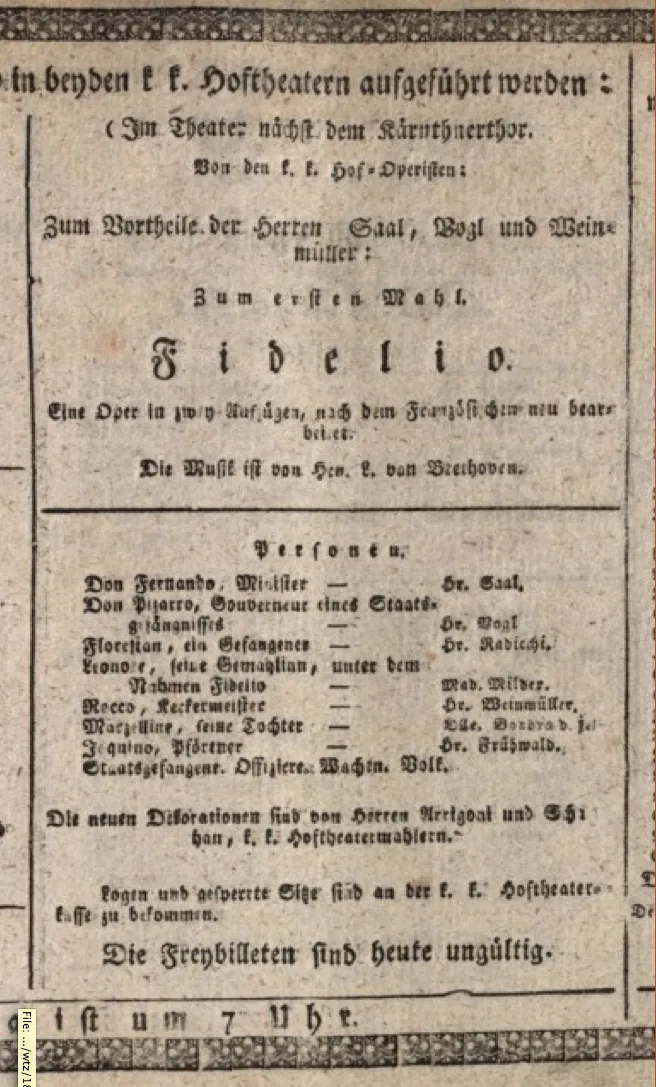
About the work
Ludwig van Beethoven's only opera, in two acts with a libretto by Joseph Sonnleithner after Jean-Nicolas Bouilly, was premiered in 1805 at the Theater an der Wien in Vienna before French occupying troops. Beethoven revised the work extensively, producing a second version in 1806 and the definitive 1814 version. The opera is a rescue drama in the tradition of the French Revolution era and celebrates marital love, political freedom, and human dignity.
Plot
Leonore, the wife of political prisoner Florestan, disguises herself as a young man named Fidelio and takes employment at the fortress where her husband is held in solitary confinement. The cruel governor Pizarro plans to murder Florestan before the arrival of an inspecting minister. When Pizarro arrives in the dungeon to kill Florestan, Fidelio reveals herself as Leonore and holds Pizarro at gunpoint. The trumpet call announcing the minister's arrival breaks the spell; Florestan is freed, Pizarro is punished, and a chorus celebrates marital fidelity and liberty itself.
Cultural significance
Fidelio occupies a singular position in the operatic canon—the only opera by history's greatest instrumental composer. The second-act quartet Mir ist so wunderbar is among the most sublime ensembles in any opera. Fidelio's central themes of political imprisonment and ultimate liberation have given the work enduring relevance: it was performed at the Staatsoper Unter den Linden on the first anniversary of the fall of the Berlin Wall and has been staged in contexts from post-Soviet Russia to apartheid-era South Africa.