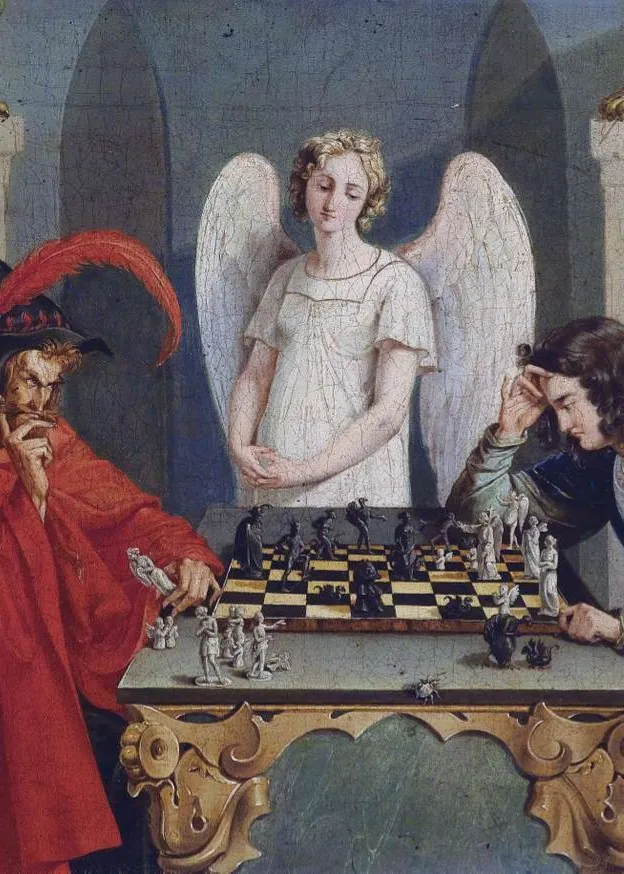
About the work
Johann Wolfgang von Goethe's „Faust. Der Tragödie zweiter Teil" was completed in August 1831 and published posthumously in 1832 — a few months after Goethe's death. Goethe had worked intensely on the second part since the 1820s; conceptually, linguistically and symbolically it differs markedly from Faust I. The first complete stage performance of both parts together took place in Weimar in 1876, directed by Otto Devrient; individual acts had occasionally been performed earlier (parts in Hamburg from 1854 onwards).
Plot
Act I — Imperial Court: Faust and Mephistopheles arrive at the court of a bankrupt emperor. Mephistopheles invents paper money and rescues the court. At a masked ball Faust conjures up by magic the beauty of Helen of Troy. Act II — Classical Walpurgis Night: Faust travels with Mephisto and Wagner's artificially created Homunculus through ancient mythology to Helen. Act III — Helen: Faust and Helen unite in a medieval castle; their son Euphorion (an allegory for Lord Byron and poetic striving) plunges from a cliff. Helen vanishes. Act IV — High Mountains / War: Faust helps the emperor in war against a counter-emperor through magic and receives in return a strip of land by the sea. Act V — Faust as coloniser: the aged, blind Faust has, with magical help and murderous hand (the old couple Philemon and Baucis perish), a utopian land created. At the moment when he imagines himself leading a free people on free ground, he says: „Stay yet, thou art so fair" — and dies. Mephisto would claim the soul, but angels — through Gretchen's contrition and the Eternal Feminine — wrest it from him. Closing chorus: „Das Ewig-Weibliche zieht uns hinan" — „The Eternal Feminine draws us upward."
Cultural significance
Faust II is one of the most complex works of world literature — an allegorical world-theatre conception that links mythology, economic history (the invention of paper money!), classical antiquity and industrial modernity. The work was long considered unstageable; only Peter Stein's famous production for Expo Hannover 2000, which presented both parts uncut in 21 hours, established Faust II on the stage. The closing lines „Das Ewig-Weibliche zieht uns hinan" and „Whoever strives with all his might, we can redeem" are among the most-quoted in German literature. Adaptations: Mahler's Eighth Symphony („Symphony of a Thousand") sets the closing act; Schnittke's Faust Cantata works with central scenes.