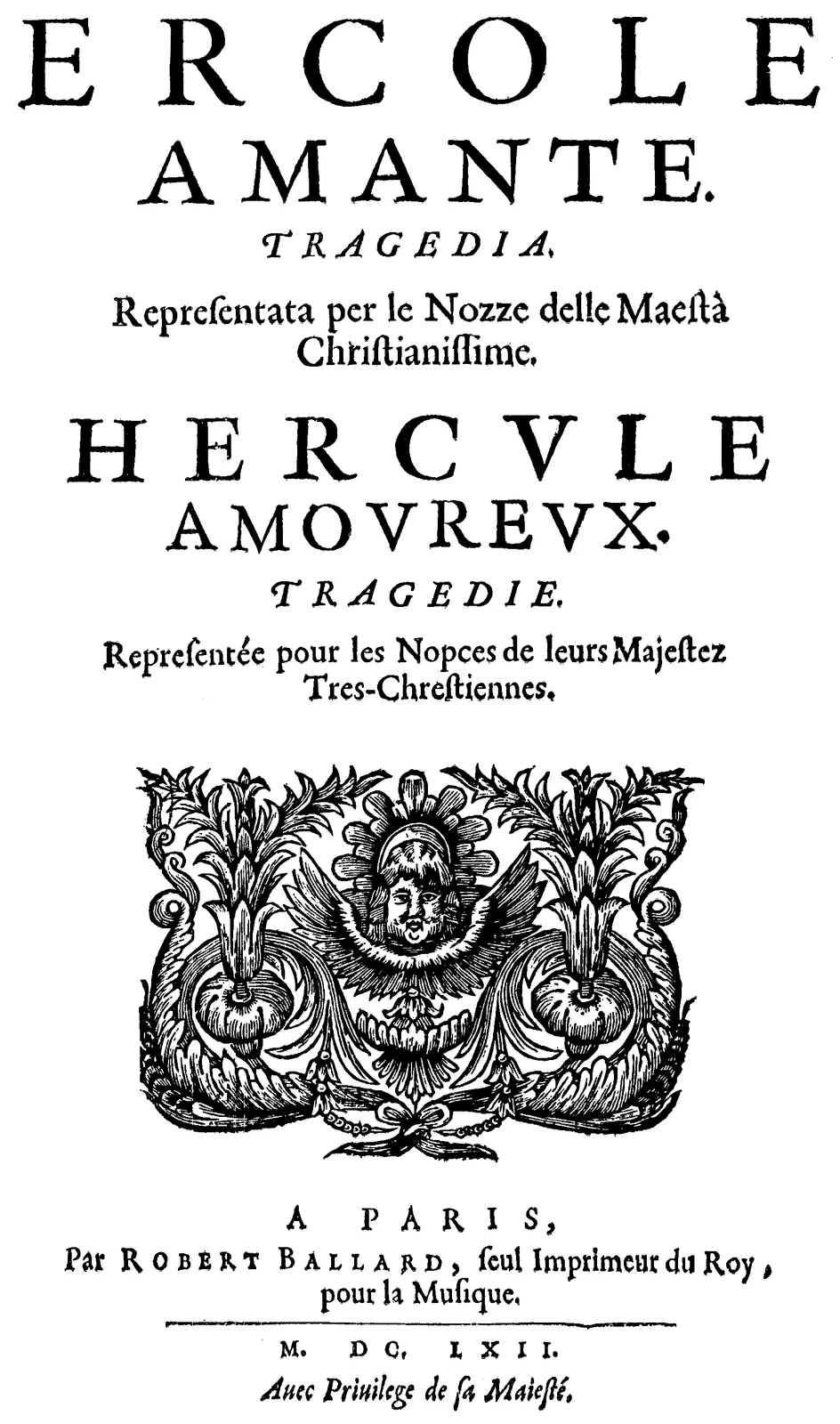
About the work
Tragedia in a prologue and five acts by Francesco Cavalli to a libretto by Francesco Buti, based on Sophocles’ "Trachiniae" and the ninth book of Ovid’s "Metamorphoses". Cardinal Mazarin commissioned the work for the 1660 wedding of Louis XIV to Maria Theresa of Spain; construction of a purpose-built theatre delayed the premiere until 7 February 1662, at the Théâtre des Tuileries in Paris.
Plot
Hercules, already married to Deianira, falls in love with the princess Iole, whose father he has killed, while Iole’s heart belongs to his son Hyllo. The goddess Venus aids Hercules with magic, and Juno seeks to thwart her; after intrigue and confusion, Hercules dies from a poisoned robe given to him by Iole, but is raised to Olympus at the end, where he marries the goddess of beauty.
Cultural significance
For the production, the architect Gaspare Vigarani built the vast "Salle des Machines" with elaborate stage machinery, and the young Jean-Baptiste Lully composed the ballet music. Audiences nonetheless preferred Lully’s French dances to Cavalli’s Italian style, so the opera met with only modest success; a disappointed Cavalli returned to Venice, and the work was not rediscovered until around 1961, some three centuries later.