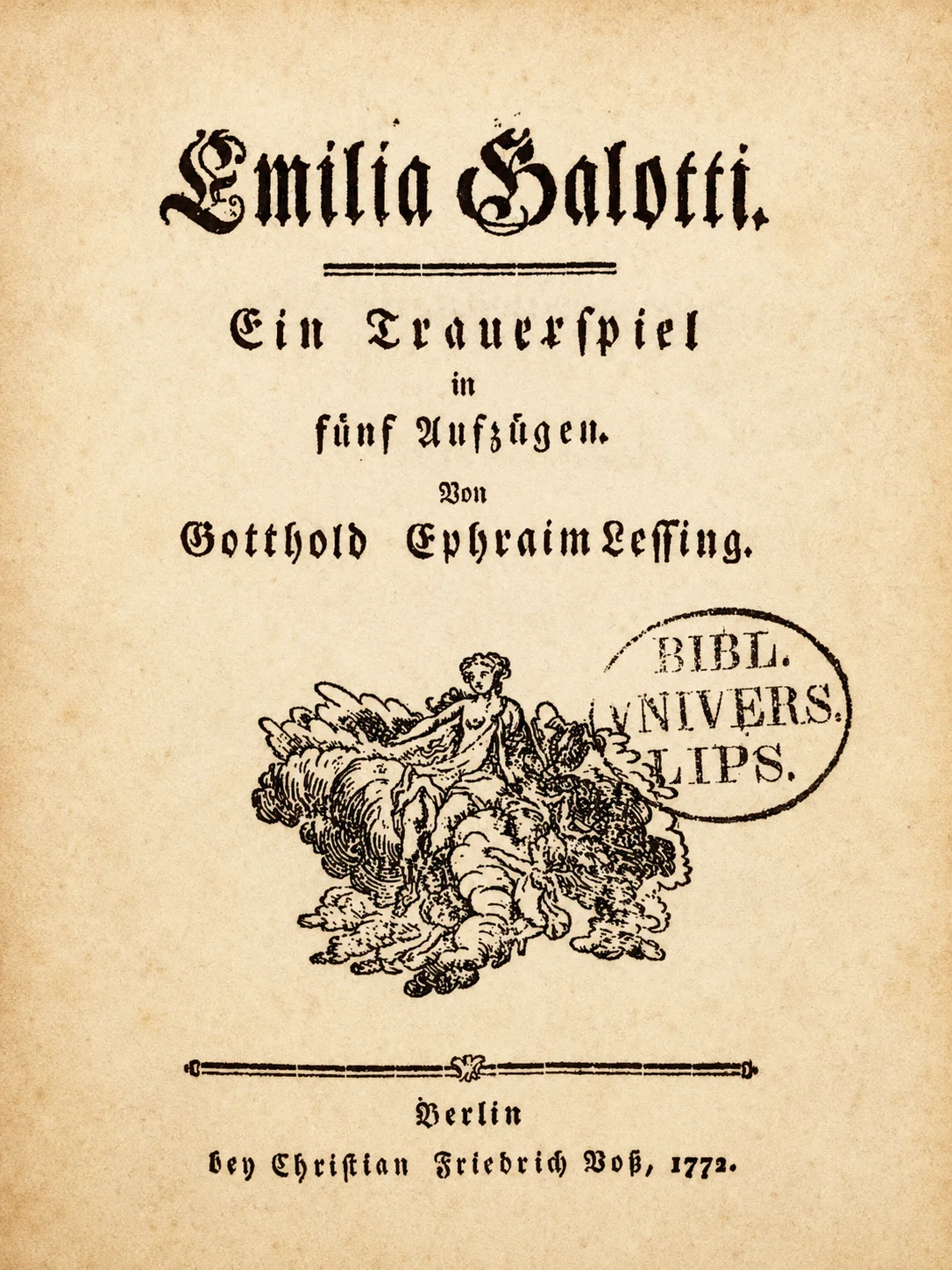
About the work
Gotthold Ephraim Lessing's bourgeois tragedy „Emilia Galotti" was first performed in Brunswick in 1772. It is regarded as a high point of the German bourgeois tragedy and as a sharp critique of the arbitrariness of absolutist princely courts. Lessing transposed the ancient Virginia story into the Italy of his own day and created a drama about the defencelessness of bourgeois virtue against courtly power.
Plot
The Prince of Guastalla, Hettore Gonzaga, is in love with the middle-class Emilia Galotti, who is to marry Count Appiani that very day. To prevent the wedding, the prince allows the unscrupulous chamberlain Marinelli to draw him into a plot. Marinelli stages an ambush on the bridal party's carriage; Appiani is shot dead and Emilia taken to the prince's pleasure palace. There Emilia's father, the upright Odoardo Galotti, gradually sees through the intrigue. The prince's cast-off former mistress, Countess Orsina, also exposes the scheming and hands Odoardo a dagger. Emilia, believing she cannot resist either her own susceptibility or the power of the court, begs her father to kill her so as to preserve her virtue. Odoardo stabs his daughter — a rose broken before the storm can strip its petals — and gives himself up to justice.
Cultural significance
Emilia Galotti is, alongside „Minna von Barnhelm" and „Nathan the Wise", Lessing's best-known drama and a fixture of school reading in German-speaking countries. The play has been read as an indictment of courtly arbitrariness and as a document of bourgeois self-assertion; in Goethe's „Werther" it lies open on the dying man's table. It is continuously present on German stages; modern productions such as Michael Thalheimer's (Deutsches Theater Berlin, 2001) gave the tragedy a radically pared-down, highly contemporary form.