About the work
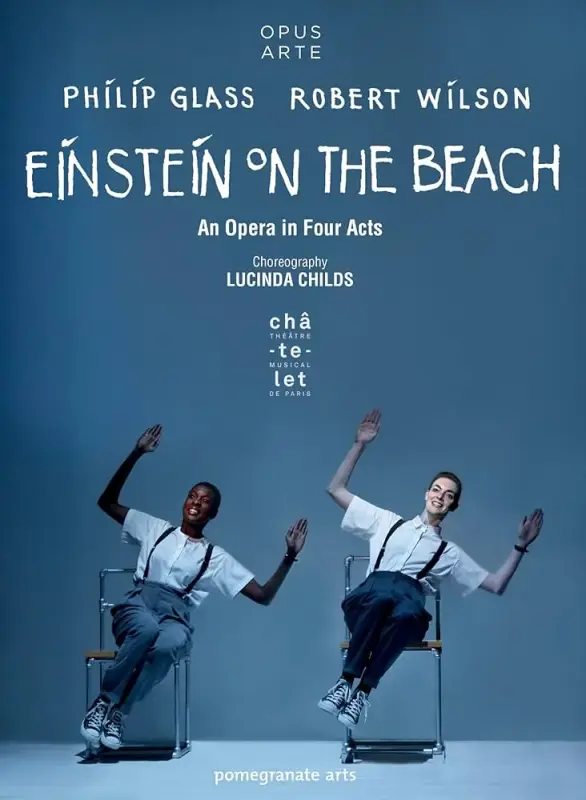
Philip Glass and Robert Wilson's „Einstein on the Beach" was premiered at the Festival d'Avignon in 1976 and is considered the most important avant-garde work of twentieth-century music theatre. With nearly five hours' duration without an interval and no plot in the conventional sense, the work struck audiences at its premiere as a shock — and freed opera from the obligation of plot and character.
Plot
„Einstein on the Beach" has NO classical plot, no characters in the operatic sense. There are four visual „Knee Plays" (connecting pieces) and four acts with nine scenes in total. Recurring images: a train, a turning panel, a bed, a spaceship, a courtroom, a violin (Einstein as solo violinist in the orchestra pit). Texts: numbers (1, 2, 3, 4 ...), solfège syllables (do, re, mi), poems by the autistic Christopher Knowles, spoken narratives by Lucinda Childs and Sheryl Sutton. The music: minimalist, slowly transforming harmonic fields, Glass's characteristic repetitive arpeggios. The work ends with a bus driver's tale of two old lovers on a bench.
Cultural significance
Einstein on the Beach revolutionised music theatre. The combination of Glass's Minimal Music with Wilson's ritual, slow visual theatre created a new form. The work caused a scandal at its first Metropolitan Opera performance in 1976 (in special performances outside the regular schedule) — the audience could come and go at will, but many stayed for five hours. Revivals in 1984, 1992 and 2012 (with the original production reconstructed) were celebrated worldwide. Influenced generations of composers and directors — Heiner Goebbels, John Adams, Saariaho. „The opera is what saved opera" (Mark Swed).