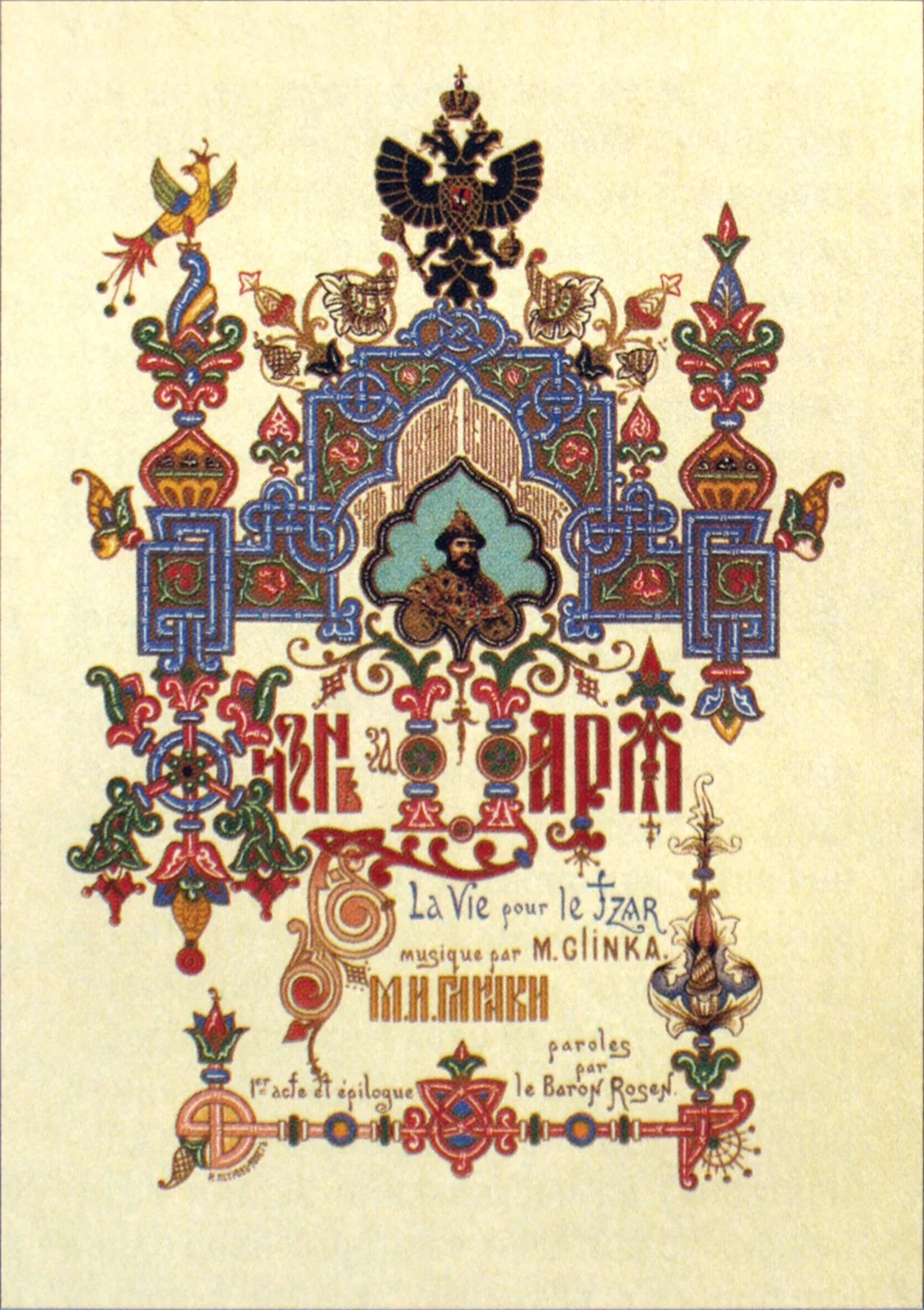
About the work
A Life for the Tsar was Mikhail Glinka's first opera; its Russian libretto was written chiefly by Baron Yegor von Rosen, with contributions from, among others, Vasily Zhukovsky. It premiered on 9 December 1836 (27 November Old Style) at the Bolshoi Kamenny Theatre in Saint Petersburg, conducted by Catterino Cavos.
Plot
In the winter of 1613, during the Polish–Russian conflict, the peasant Ivan Susanin deliberately leads Polish soldiers hunting the newly elected Tsar Michael Romanov into an impassable forest. His adopted son manages to warn the Tsar in time, while Susanin sacrifices his own life to secure the escape.
Cultural significance
Glinka originally called the work Ivan Susanin but renamed it at the wish of Tsar Nicholas I. It is regarded as the first Russian opera to hold a permanent place in the repertoire and influenced later composers such as Mussorgsky and Rimsky-Korsakov. Because of its pro-tsarist plot, the Soviet Union suppressed the work for a time; in 1939 it returned with a revised libretto under the old title Ivan Susanin, reverting to its original title after 1991.