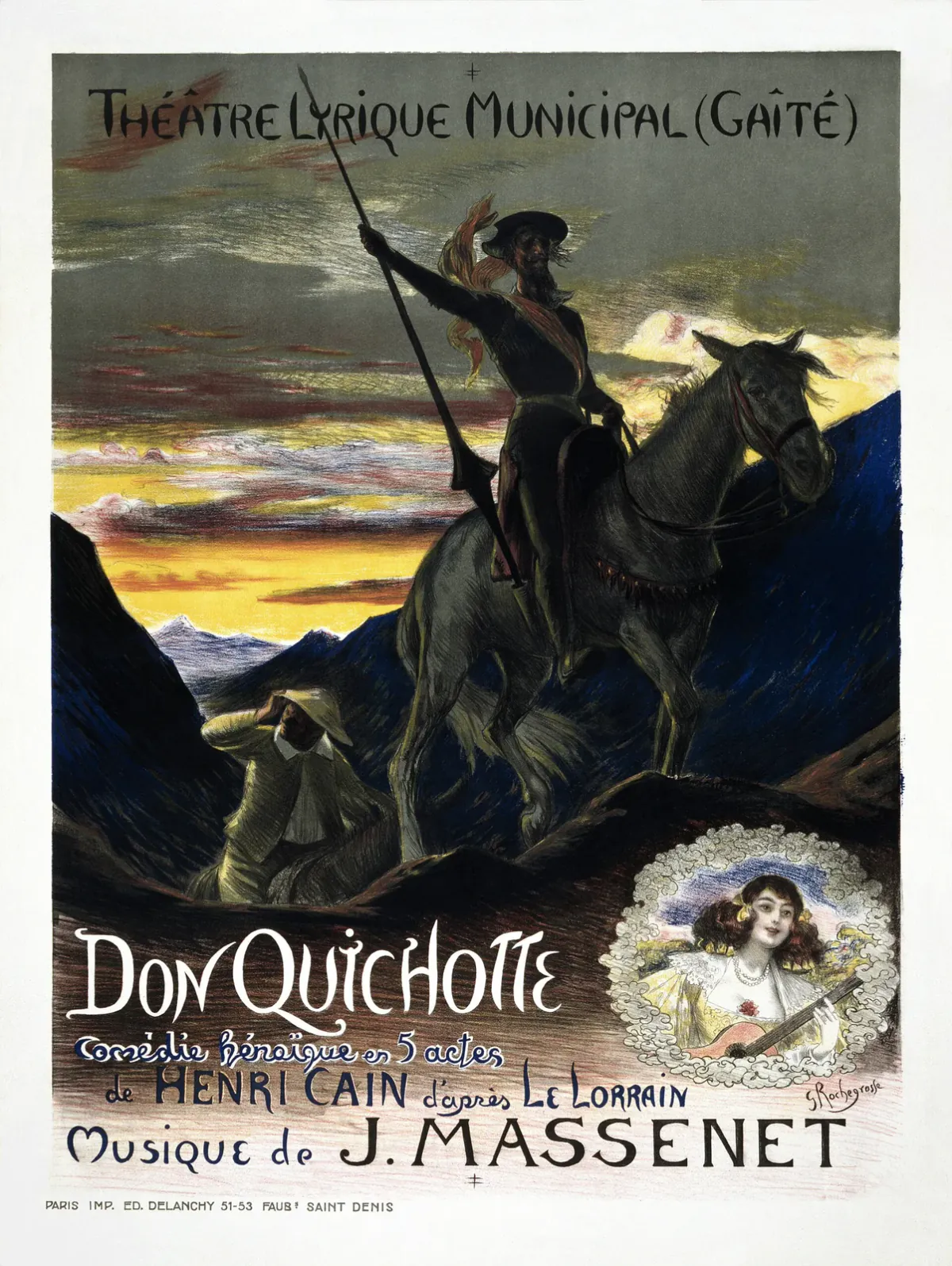
About the work
Comédie héroïque in five acts by Jules Massenet, first performed on 19 February 1910 at the Opéra de Monte-Carlo with a libretto by Henri Cain. Its source is not Cervantes' novel directly but Jacques Le Lorrain's play 'Le Chevalier de la Longue Figure' (1904), which turns the simple peasant girl Aldonza into the coquettish Dulcinée.
Plot
The elderly knight Don Quichotte falls for the beautiful Dulcinée and sets out with his servant Sancho Pança to recover a pearl necklace stolen from her by bandits. Having won the bandits over through sheer good nature, he proposes to Dulcinée, who turns him down kindly but firmly. Disappointed, Don Quichotte withdraws to die, believing in his final moments that he hears Dulcinée's voice calling from another world.
Cultural significance
Massenet wrote the title role for the Russian bass Feodor Chaliapin and Dulcinée for the contralto Lucy Arbell, with whom the 67-year-old composer was himself in love. One of six works the impresario Raoul Gunsbourg commissioned from Massenet for Monte Carlo, Don Quichotte became the last of his opera premieres he lived to see; he died two years later.