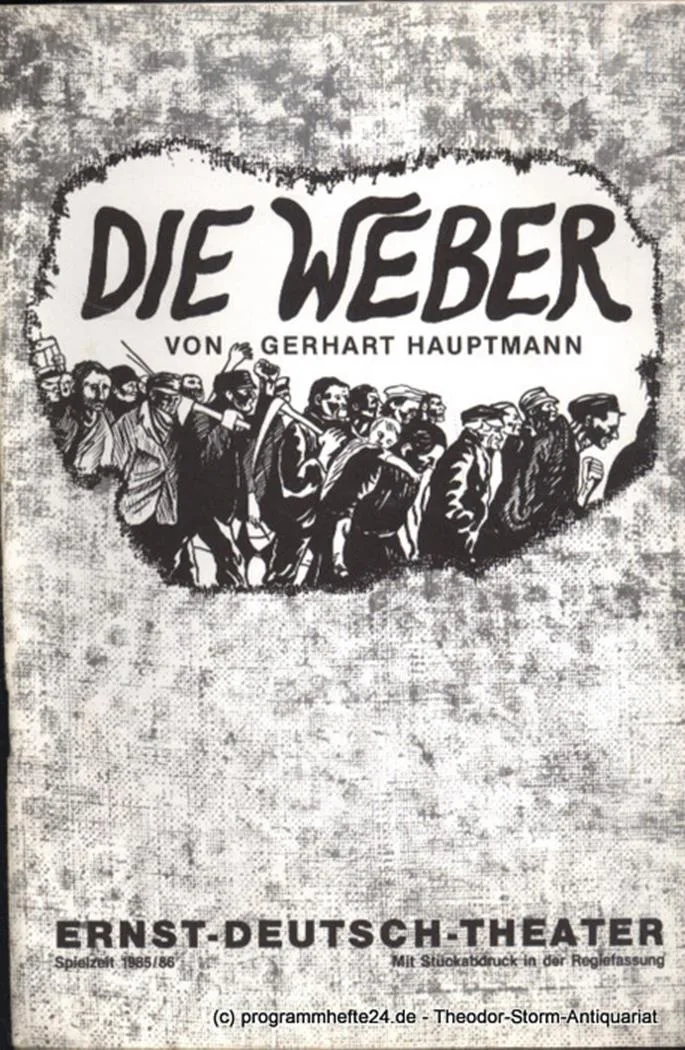
About the work
The Weavers is a social drama in five acts by Gerhart Hauptmann, premiered in 1893. It is regarded as the major work of German Naturalism and one of the first dramas to make not a single hero but an entire social group—the mass—its protagonist. Hauptmann drew on the real uprising of the Silesian weavers of 1844.
Plot
In the 1840s the Silesian weavers live in the bitterest poverty while the manufacturer Dreissiger pushes wages ever lower. Hunger, illness, and despair mark their daily lives. Spurred on by the song "The Bloody Judgment" and by returning, rebellious weavers such as Jäger, dull resignation gradually turns into open revolt. The weavers storm the manufacturer's house and destroy his machines. The uprising spreads but is finally crushed by the military—and it is the pious, violence-rejecting old Hilse who falls to a stray bullet.
Cultural significance
The Weavers was highly political at its creation and was initially banned, as the authorities feared it as a call to class struggle. With its depiction of collective misery, its use of the Silesian dialect, and its renunciation of a classical single hero, Hauptmann revolutionised drama. The work became the epitome of socially critical theatre and contributed substantially to Hauptmann's later receipt of the Nobel Prize in Literature.