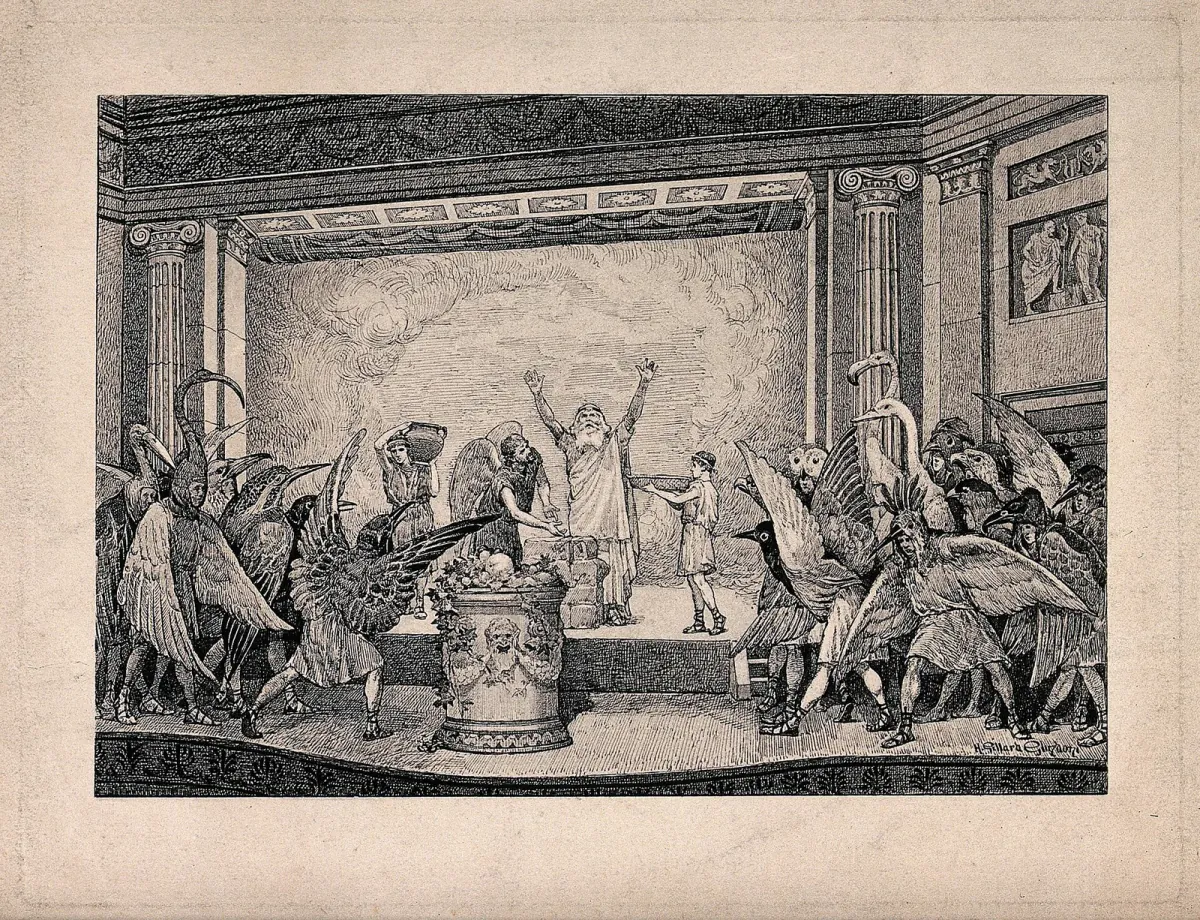
About the work
Aristophanes's „The Birds" was performed at the Great Dionysia in Athens in 414 BCE and is among the most famous comedies of antiquity. The play is a fantastical political satire about two Athenians who flee their litigious city and found a utopian state in the realm of the birds. At over 1,700 lines it is the longest surviving work of Aristophanes.
Plot
The two Athenians Pisthetairos and Euelpides, weary of a home city consumed by lawsuits and politics, seek out the Hoopoe — once a man, now king of the birds. Pisthetairos persuades the initially suspicious birds to a bold plan: to build a fortified city in the clouds between heaven and earth — „Cloud-Cuckoo-Land" — and thereby control the link between mortals and gods. Since the sacrifices of men can no longer rise to the gods, the Olympians fall into distress. Assorted uninvited guests — poets, soothsayers, officials, a would-be parricide — push into the new city and are driven off. At last Olympus must capitulate: an embassy of Poseidon, Heracles and a barbarian god negotiates a treaty. Pisthetairos receives the sceptre of universal rule and the goddess Basileia as his bride; the play ends in a triumphant wedding procession.
Cultural significance
The Birds is regarded as the high point of Old Comedy and one of the earliest works of utopian literature. „Cloud-Cuckoo-Land" has entered many languages as a byword for fanciful castles in the air. The play combines biting topical satire with poetic fantasy and musical choral passages. It has been set and staged many times, including in Walter Braunfels's opera „Die Vögel" (1920), and remains a fixture of the ancient-theatre repertoire.