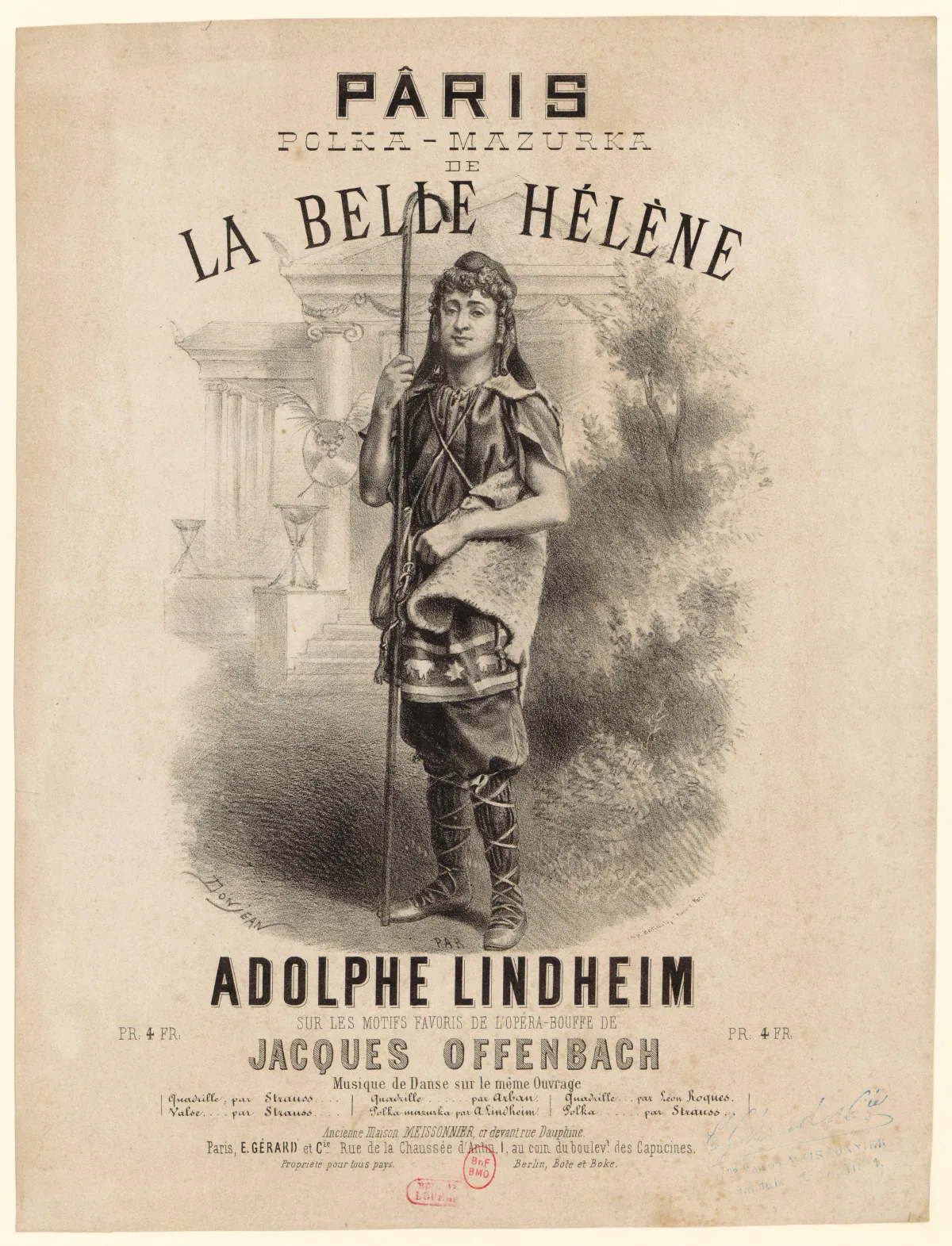
About the work
La belle Hélène (The Beautiful Helen) is an operetta by Jacques Offenbach, premiered in Paris in 1864. The libretto by Henri Meilhac and Ludovic Halévy wittily parodies the Greek mythology surrounding the beautiful Helen and the Trojan War and is regarded as one of Offenbach's most perfect operettas.
Plot
Queen Helen of Sparta, the most beautiful woman in the world, is bored in her marriage to the sluggish King Menelaus. The goddess Venus has promised the Trojan prince Paris the love of Helen. When Paris, in disguise, comes to the Spartan court and wins a contest of wits, a passionate attraction flares between him and Helen. While the Greek kings are caricatured as vain fools, Paris finally abducts the only half-reluctant Helen—the beginning of the Trojan War.
Cultural significance
La belle Hélène is a high point of Offenbachian social satire, which under the guise of antiquity targets the decadence and double standards of the Second Empire. With catchy melodies, cheeky wit, and the splendid role of Helen, it became an international perennial success. The work is part of the standard repertoire of operetta houses and is regarded as the epitome of the esprit-filled French genre.