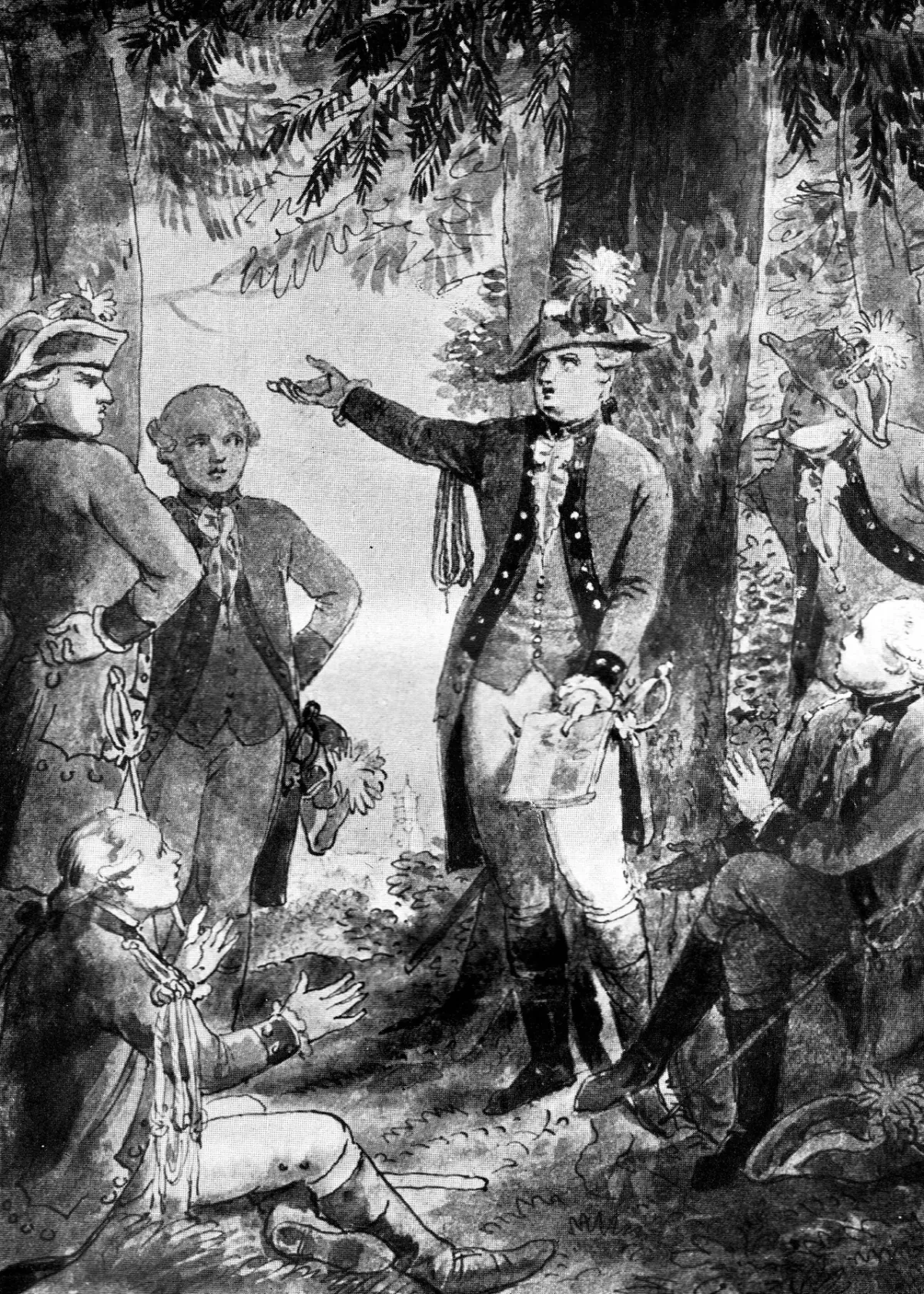
About the work
Friedrich Schiller's play „Die Räuber" was written in 1781 and premiered at the Mannheim National Theatre in 1782 — Schiller's debut and one of the most influential texts of Sturm und Drang. The work made the 22-year-old Schiller famous overnight; the Mannheim premiere is regarded as a legendary theatrical scandal.
Plot
Eighteenth century. Karl von Moor, noble son of Count Maximilian von Moor, studies in Leipzig. His elder brother Franz, envious and physically deformed, intercepts Karl's letters and intrigues against him with the father — inventing crimes Karl has supposedly committed. The aged father disowns Karl. Karl, broken and betrayed, becomes a robber chief in the Bohemian forest. With his band he marauds through the land, dreaming of a new social order. Meanwhile Franz pursues his plot: he locks his father in a tower-dungeon to be officially declared dead; he covets Karl's fiancée Amalia. Karl returns disguised to the castle, finds Amalia again, discovers his father in the dungeon and vows revenge. The robbers storm the castle — Franz hangs himself, the father dies of shock. Karl ends with the robbers: he has stabbed Amalia (at her own request), because as a sworn outlaw he cannot marry her. In his closing monologue Karl resolves to give himself up to a poor day labourer for the bounty on his head, so that the labourer's family may benefit.
Cultural significance
Die Räuber is one of the most influential texts of Sturm und Drang and shaped early Romantic drama, the bandit-romance genre and the political symbolism of the French Revolution. Verdi set the material as „I masnadieri" (1847). Karl Moor is the iconic figure of the morally complex outsider — like Robin Hood but tragically ending. Standard repertoire on German stages; productions by Frank Castorf (Volksbühne 1990) and Nicolas Stemann (Thalia 2008) are reference performances.