About the work
Aeschylus's „Oresteia" was premiered in Athens in 458 BCE — the only completely preserved tragic trilogy of ancient Greece, comprising „Agamemnon", „The Libation Bearers" („Choephoroi") and „The Eumenides". Aeschylus won first prize at the festival.
Plot
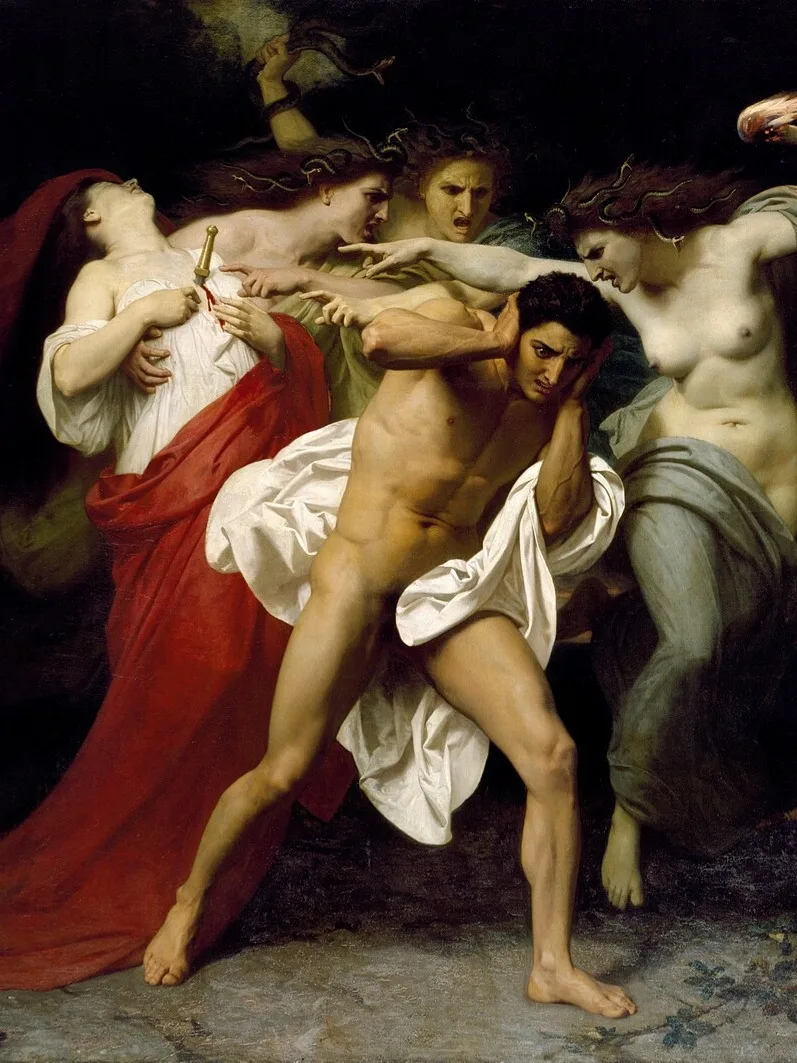
Agamemnon: King Agamemnon of Argos returns home from the Trojan War — with the captive Trojan princess Cassandra. His wife Clytemnestra, who has not forgiven him for sacrificing their daughter Iphigenia ten years earlier and has taken Aegisthus as her lover, kills Agamemnon and Cassandra in the bath. The Libation Bearers: Years later. Agamemnon's son Orestes returns from exile, urged by Apollo to avenge his father. Together with his sister Electra he kills Aegisthus and his own mother Clytemnestra. Immediately the Erinyes (Furies) appear and pursue Orestes. The Eumenides: Orestes flees to the temple of Athena. There a court of citizens is held to judge whether matricide is justifiable. Apollo argues for Orestes, the Furies for the dead Clytemnestra. The vote is tied — Athena casts the deciding vote for Orestes. The Furies are pacified and become the „Eumenides" (the Kindly Ones). The cycle of blood-vengeance ends; the rule of law begins.
Cultural significance
The Oresteia is the most performed and adapted ancient tragic trilogy. The transition from blood revenge to constitutional law in „The Eumenides" is foundational for Western legal thought. Productions by Peter Stein (Schaubühne 1980), Peter Hall (National Theatre 1981) and Robert Icke (Almeida 2015) are reference stagings. The trilogy has shaped Strauss's „Elektra" and modern psychoanalytic theatre.