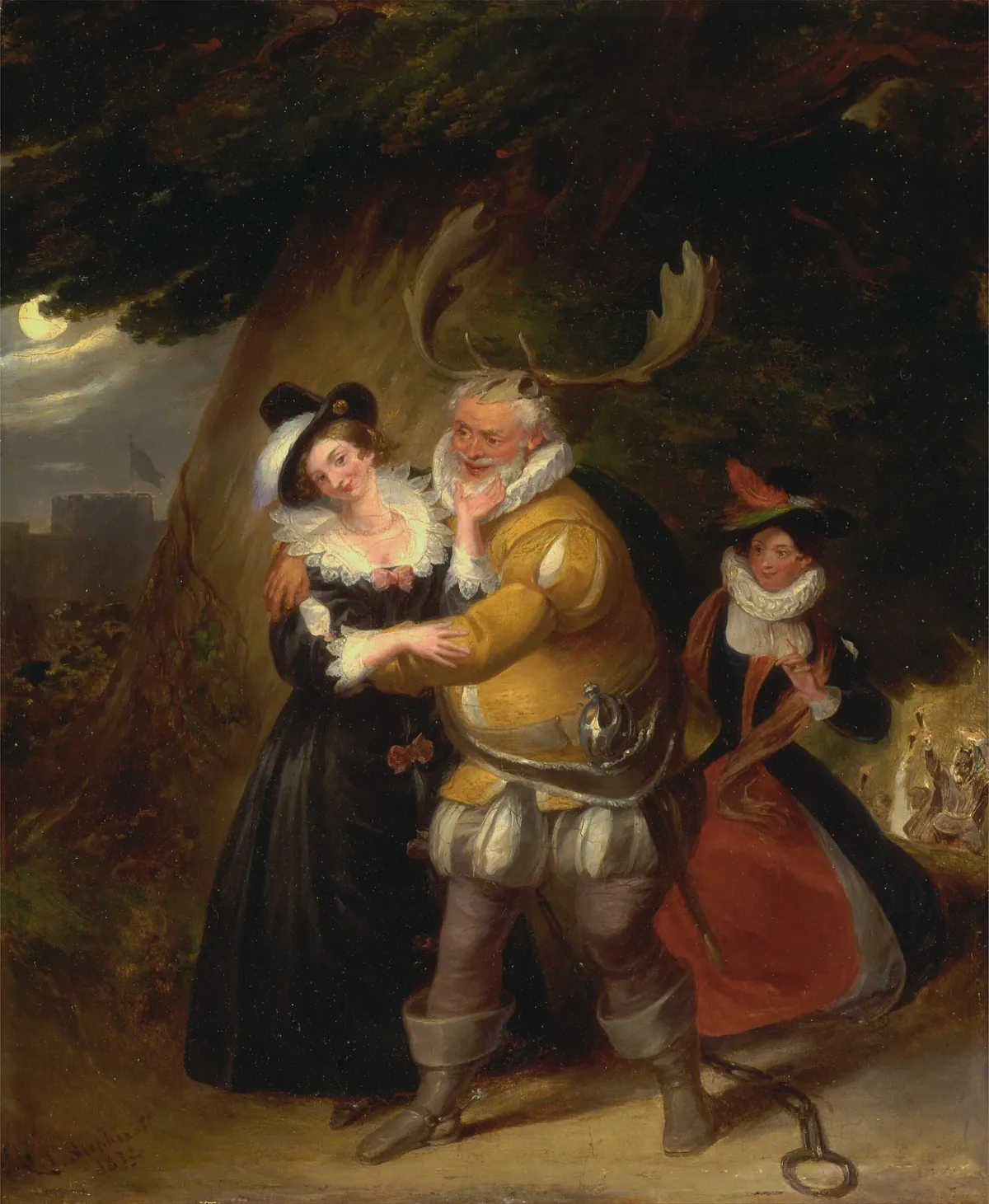
About the work
Comedy by William Shakespeare, probably written around 1597/98 and printed as a quarto in 1602; no performance during the author's lifetime is documented, and the earliest recorded performance took place on 4 November 1604 at court in Whitehall. It centres on Sir John Falstaff, the knight already familiar from the Henry IV plays.
Plot
Short of money, Falstaff tries to seduce two wealthy Windsor wives, Mistress Ford and Mistress Page, at the same time, sending them identical love letters in the hope of getting at their husbands' wealth. The women see through the scheme, compare notes and humiliate him through a series of pranks, including having him dumped in the river inside a laundry basket and beaten while disguised as the "old woman of Brentford". In a parallel plot, the Pages' daughter Anne is courted by several suitors but ultimately marries Fenton, the man of her choice, against her parents' wishes.
Cultural significance
The play remains one of Shakespeare's most frequently staged comedies and inspired numerous operatic adaptations, including Otto Nicolai's Die lustigen Weiber von Windsor (1849) and Giuseppe Verdi's Falstaff (1893).