About the work
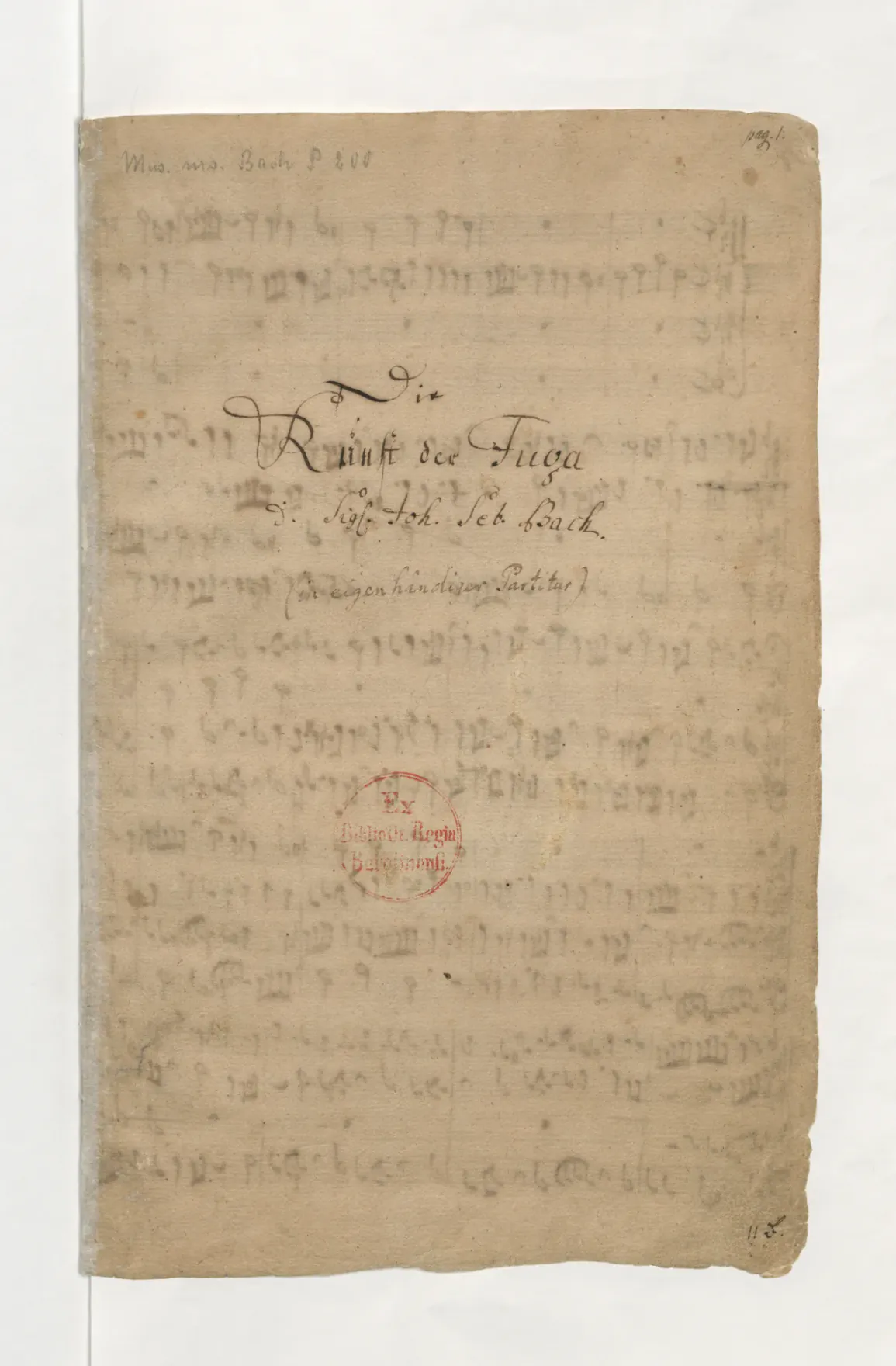
Johann Sebastian Bach's „The Art of Fugue" (BWV 1080) is Bach's last great work and was published posthumously in 1751. It contains 14 fugues (Bach called them „Contrapuncti") and four canons — all on the same D minor theme. The work is a systematic demonstration of the possibilities of the theme and is regarded as Bach's intellectual testament.
Plot
The collection works through all stages of fugal technique: simple fugues (Contrapunctus 1-4), counter-fugues with the inverted theme (5-7), double and triple fugues (8-11), mirror fugues in which the whole fugue appears mirrored (12-13), and finally the famous Contrapunctus 14 — a four-voice fugue on three themes that breaks off abruptly after 239 bars. Carl Philipp Emanuel Bach wrote on the manuscript: „Above this fugue, in which the name BACH was introduced in the countersubject, the composer died." The B-A-C-H motif (B flat - A - C - B natural in German notation) appears as the third theme. The question of whether Bach failed to complete the fugue or whether a closing section is lost is one of the great mysteries of musical history. Four canons on the same theme stand at the end of the collection.
Cultural significance
The Art of Fugue is regarded as Bach's contrapuntal legacy and the high point of fugal art. Bach did not specify any instrumentation — the pieces can be played on harpsichord, organ, string quartet or chamber orchestra, and all versions are performance-practically legitimate. The question of the unfinished Contrapunctus 14 has occupied generations; Helmut Walcha, Davitt Moroney and others have composed possible continuations. Famous recordings: Helmut Walcha (organ), Hermann Scherchen (orchestra), Glenn Gould (fragmentary), Davitt Moroney (harpsichord), Pierre-Laurent Aimard (piano), Akademie für Alte Musik Berlin.