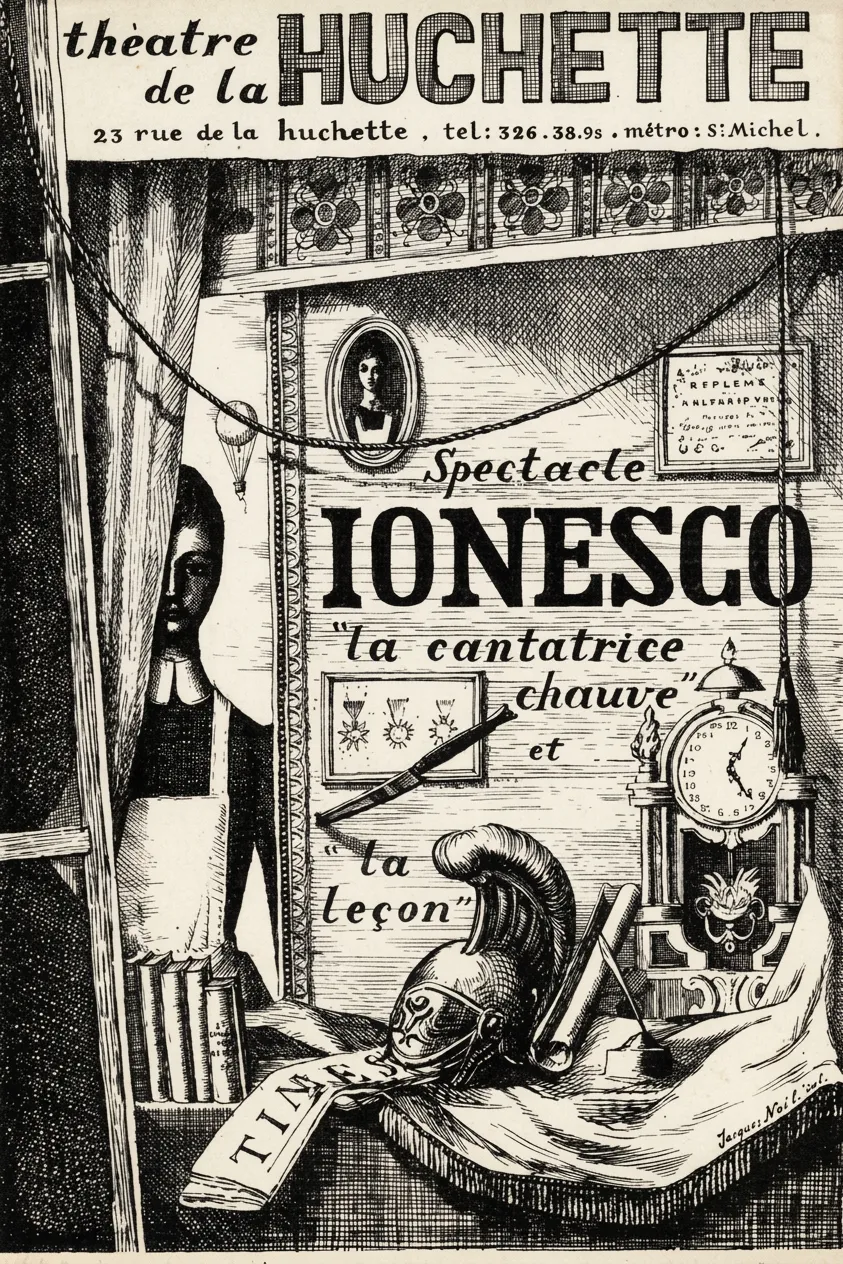
About the work
Eugène Ionesco's „The Bald Soprano" („La Cantatrice chauve") was premiered at the Théâtre des Noctambules in Paris in 1950. The author called his first work an „anti-play". It is regarded as a founding work of the theatre of the absurd and grew out of Ionesco's bewilderment at the mechanical model sentences of an English-language primer.
Plot
In a typically English living room the Smith couple exchange banal, increasingly nonsensical platitudes. The Martin couple come to visit and, after a long, pseudo-logical chain of reasoning, „discover" with astonishment that they are married to each other and sleep in the same bed. The maid Mary and a Fire Chief looking for fires join them and tell pointless anecdotes. The conversation derails ever further, until language disintegrates into pure scraps of sound, repetitions and disconnected syllables. A „bald soprano" never appears; to a passing question about her, the only reply is that she „always wears her hair the same way". At the end the play begins again — now with the Martins in place of the Smiths.
Cultural significance
„The Bald Soprano" is the founding text of the theatre of the absurd and a radical critique of language: it demonstrates how bourgeois communication freezes into an empty shell. At the Théâtre de la Huchette in Paris the play has run continuously since 1957 and is regarded as the longest-running theatrical production in the world. With it Ionesco became, alongside Beckett, the most important representative of the absurd.