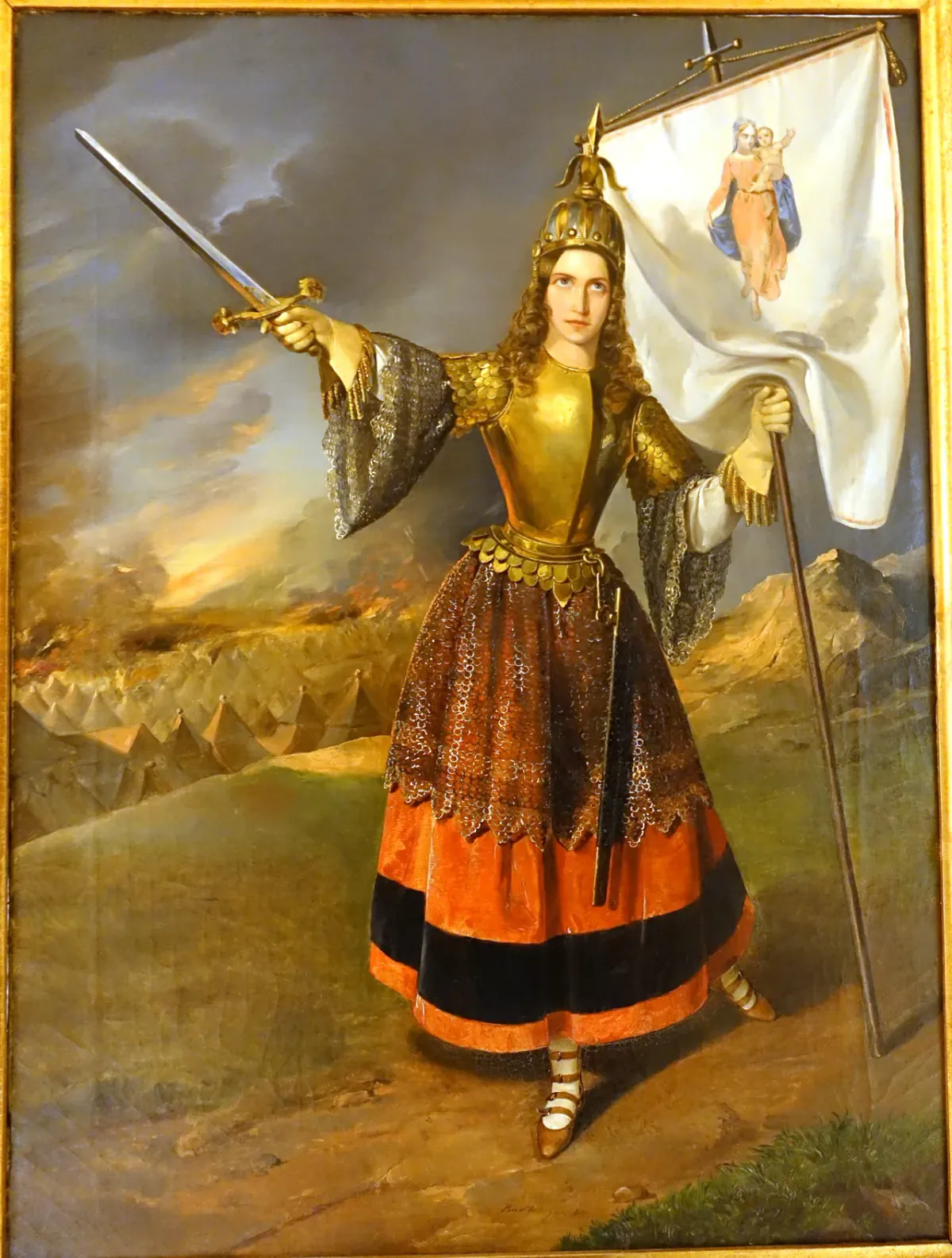
About the work
Friedrich Schiller's play in five acts was written in 1801 and premiered in Leipzig the same year. The „Romantic tragedy" about the French heroine Joan of Arc fuses historical material with visionary symbolism and is one of Schiller's most popular works — even though he altered Joan's historical fate (burning at the stake in 1431) in favour of a death in battle.
Plot
France, 1429. The country has been almost overrun by the English, Charles VII has not yet been crowned. In a village prologue the young shepherdess Johanna receives a divine vision — she is to embody the Holy Virgin and free France. She leaves her father and her fiancé Raimond, comes to Charles's court, where supernatural knowledge convinces the despairing king of her mission. She leads the French army in battle — breaks the English spell. But at a central moment her vocation falters: Johanna meets the handsome young English commander Lionel and cannot kill him — she realises that she loves. This weakness breaks her mission. She is taken prisoner and, before the people, accused of witchcraft by her own father. In the dungeon she prays; her chains miraculously break — she rushes to the battle, turns defeat to victory, but dies in Charles's arms.
Cultural significance
Die Jungfrau von Orleans is, after „Wilhelm Tell", one of Schiller's most popular works and shapes the German view of Joan of Arc. Schiller's radical alteration of her historical death (battle instead of burning) is seen as a deliberate break with history in favour of poetic redemption. Tchaikovsky's opera „The Maid of Orleans" (1881) builds on Schiller. Productions by Frank Castorf and Stephan Kimmig have given the play new readings for the present.