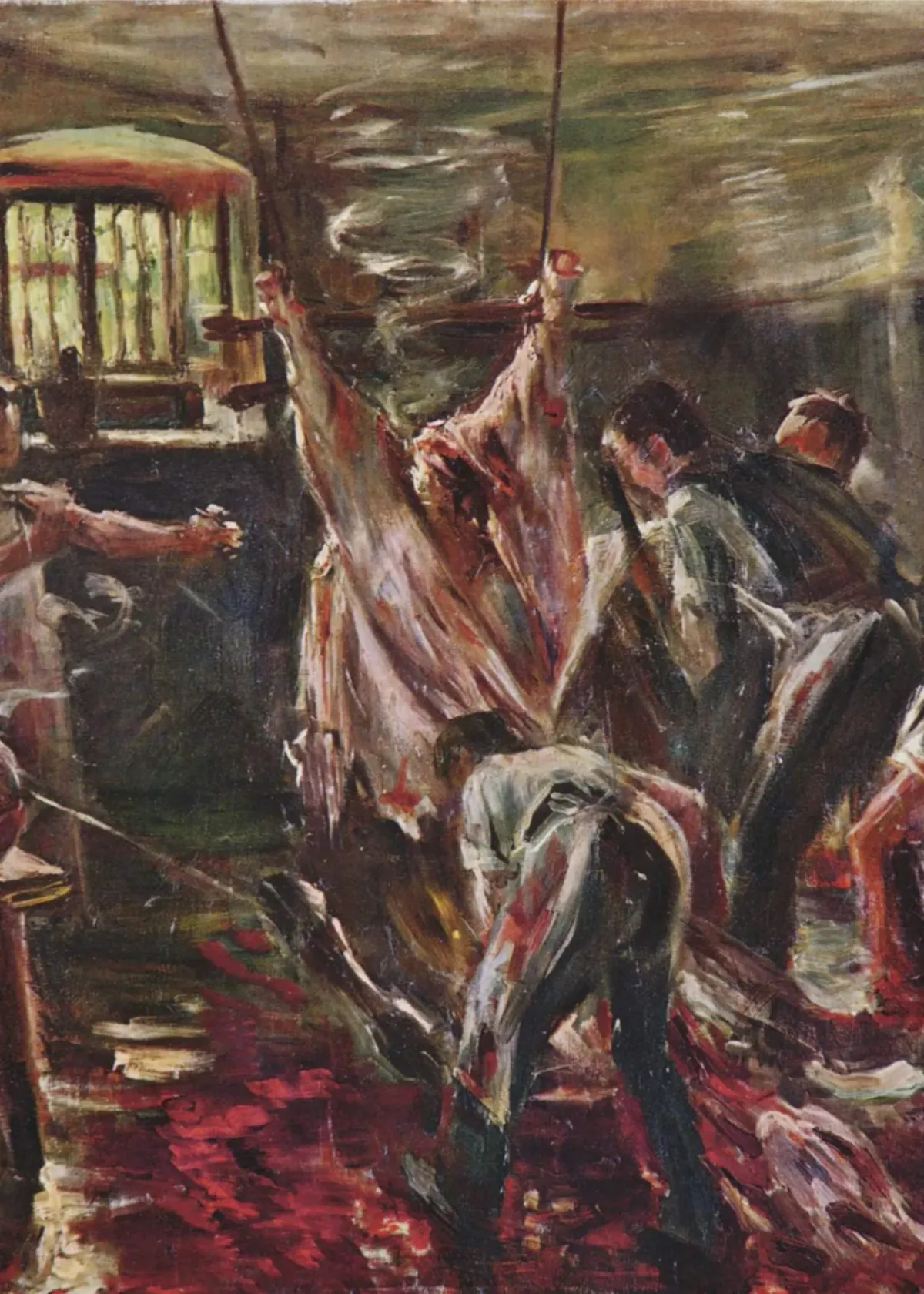
About the work
Die heilige Johanna der Schlachthöfe (Saint Joan of the Stockyards) is a play by Bertolt Brecht, written between 1929 and 1931 in the midst of the Great Depression. It was first broadcast as a radio play in 1932; the staged premiere did not follow until 1959 at the Schauspielhaus Hamburg. The play combines the figure of Saint Joan with a Marxist analysis of capitalism and is written in strict blank verse schooled on Schiller and Goethe — which Brecht turns parodistically against its own lofty tone.
Plot
In the stockyards of Chicago the workers struggle against hunger, mass layoffs and the speculations of the meat king Pierpont Mauler. The pious Johanna Dark, a lieutenant of the "Black Straw Hats" (a Salvation-Army-like organisation), wants to help the workers and to discover who is to blame for their misery. In three "descents into the depths" she seeks out Mauler and believes she can convert him to humanity. But Mauler coldly exploits her credulity for his stock-market manoeuvres. Johanna realises too late that "only force helps where force rules", and that pity and faith cannot change the conditions. As she dies, her radical insight is drowned out by the songs of the capitalists, who transfigure her into a harmless martyr — the "Saint Joan of the Stockyards".
Cultural significance
Die heilige Johanna der Schlachthöfe is regarded as one of Brecht's most important didactic plays and the high point of his early Marxist drama. The montage of classical verse drama, biblical quotation and economic analysis makes the work one of the most ambitious theatrical undertakings of the Weimar era. It belongs to the standard repertoire of major stages; significant productions were created by Benno Besson and Frank Castorf, among others. The figure of Johanna Dark stands in a line with the great treatments of Joan of Arc by Schiller and Shaw.