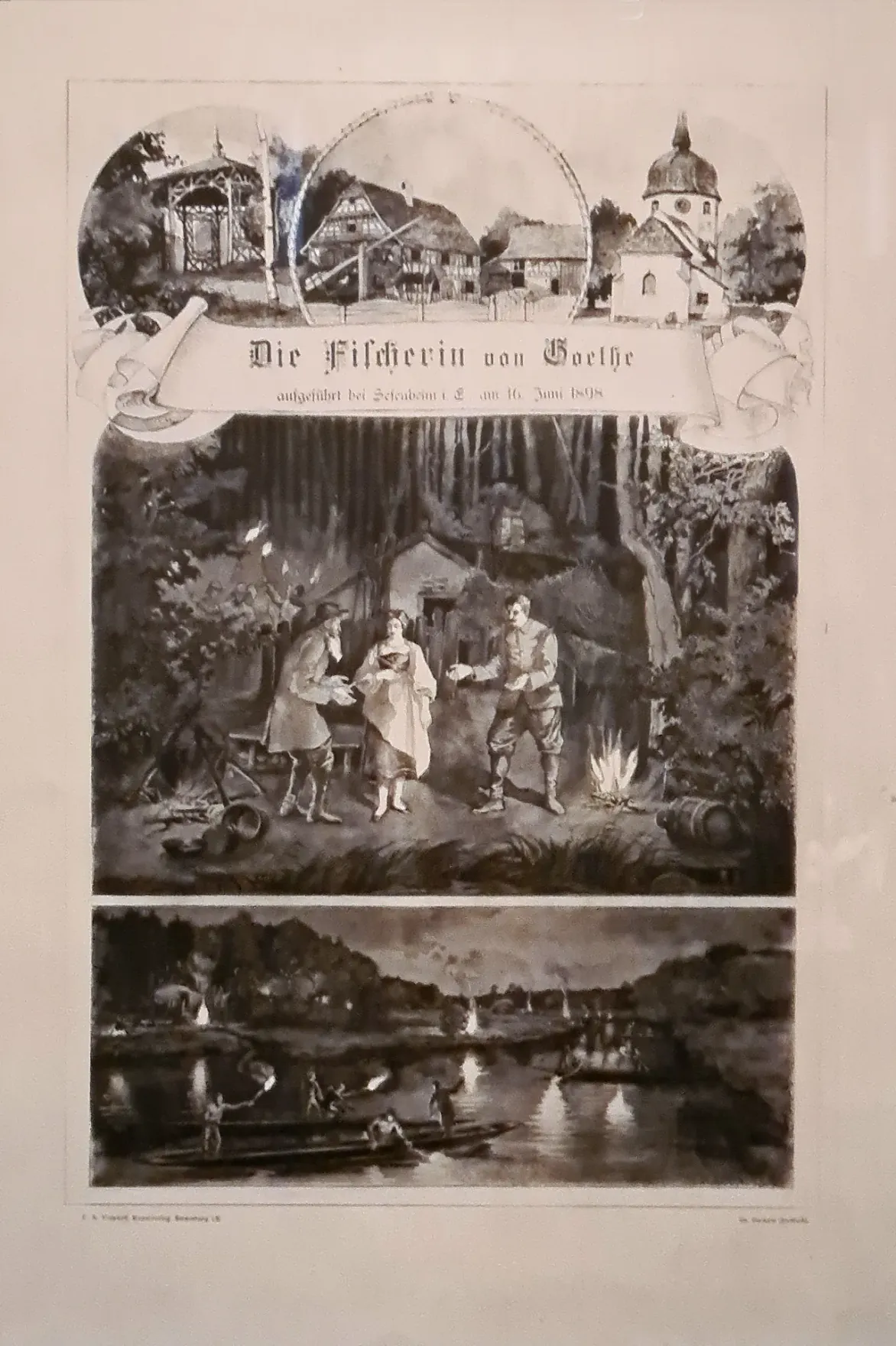
About the work
Johann Wolfgang von Goethe's one-act Singspiel was premiered in 1782 as a summer piece in Tiefurt Park near Weimar — an open-air performance on the bank of the Ilm for which Corona Schröter composed the music and sang the title role. The work belongs to Goethe's Weimar aesthetic of lived festival-play and contains the famous ballad Der Erlkönig, sung in the play by the title figure.
Plot
Dortchen, a young fisher's daughter, is angry with her fiancé Niklas and her father, who constantly patronise her. To teach them a lesson she stages her own drowning — lays her shawl at the shore and hides in the forest. Niklas and the father fall into desperate search and guilt. Dortchen returns at the end, and the two men promise to respect her freedom in future. During the action Dortchen sings the Erlkönig ballad.
Cultural significance
Die Fischerin is scarcely known today as an independent play but contains one of the most frequently set texts in world literature — the Erlkönig, which Goethe first presented publicly here. Franz Schubert's 1815 setting became his first internationally famous work and is among the foundations of the German art song. The premiere performances by Corona Schröter in Tiefurt Park are considered early examples of European open-air theatrical aesthetics.