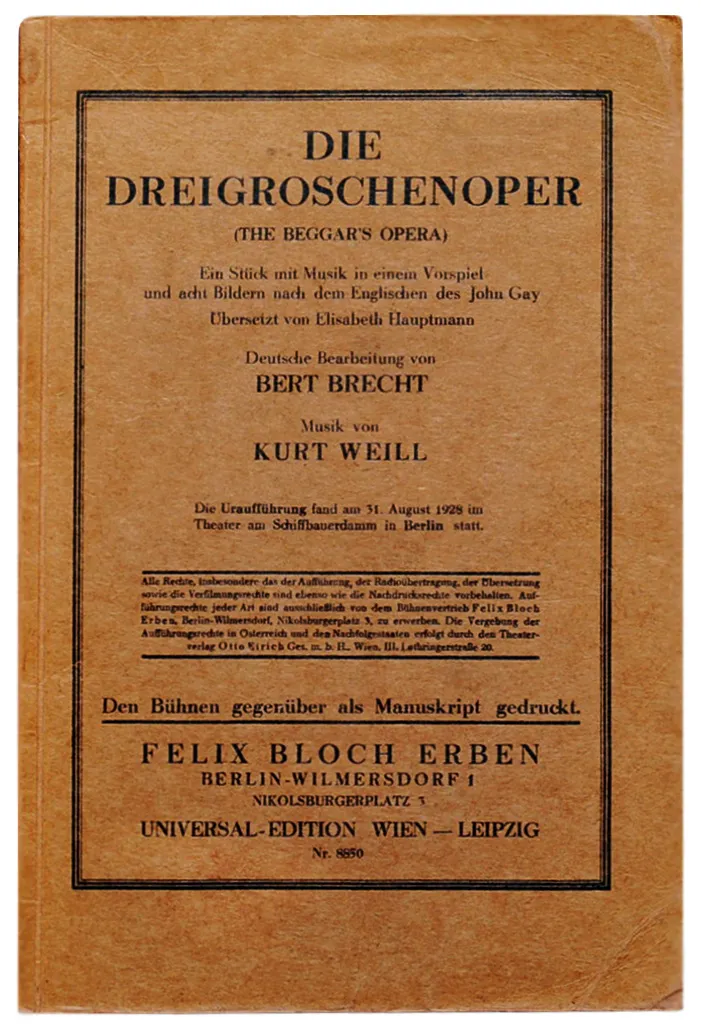
About the work
Bertolt Brecht and Kurt Weill's „Die Dreigroschenoper" was premiered at the Theater am Schiffbauerdamm in Berlin in 1928. The adaptation of John Gay's „The Beggar's Opera" (1728) became the greatest theatrical success of the Weimar Republic and to this day shapes the German conception of the „Songspiel".
Plot
London, Victorian era. Macheath, „Mackie Messer", leader of a gang of criminals, has married Polly Peachum — daughter of the beggar-king Jonathan Peachum. Peachum, who runs an empire of beggars and extortionists, is enraged. He blackmails the chief of police Tiger Brown, once Mackie's war comrade and patron of his business, into arresting Mackie. Mackie hides with the prostitute Jenny in a brothel — is betrayed, caught and locked in jail. Lucy Brown, daughter of the police chief and also Mackie's „wife", helps him escape. But Peachum threatens to disrupt Queen Victoria's coronation festivities with his beggar demonstration unless Mackie hangs. Mackie is recaptured. On the gallows — just before execution — comes the „mounted messenger of the queen": Mackie is pardoned, ennobled, raised in rank and given a lifelong pension. Brecht's ironic comment: „Do not pursue injustice too zealously."
Cultural significance
The Threepenny Opera is the most influential German music-theatre work of the twentieth century. „Mack the Knife", „Pirate Jenny" and „The Ballad of the Easy Life" are global songbook classics — Louis Armstrong, Frank Sinatra, Bobby Darin, Ute Lemper and Sting have all recorded them. Bobby Darin's 1959 „Mack the Knife" became a US number-one hit. G. W. Pabst's 1931 film made the work internationally popular.