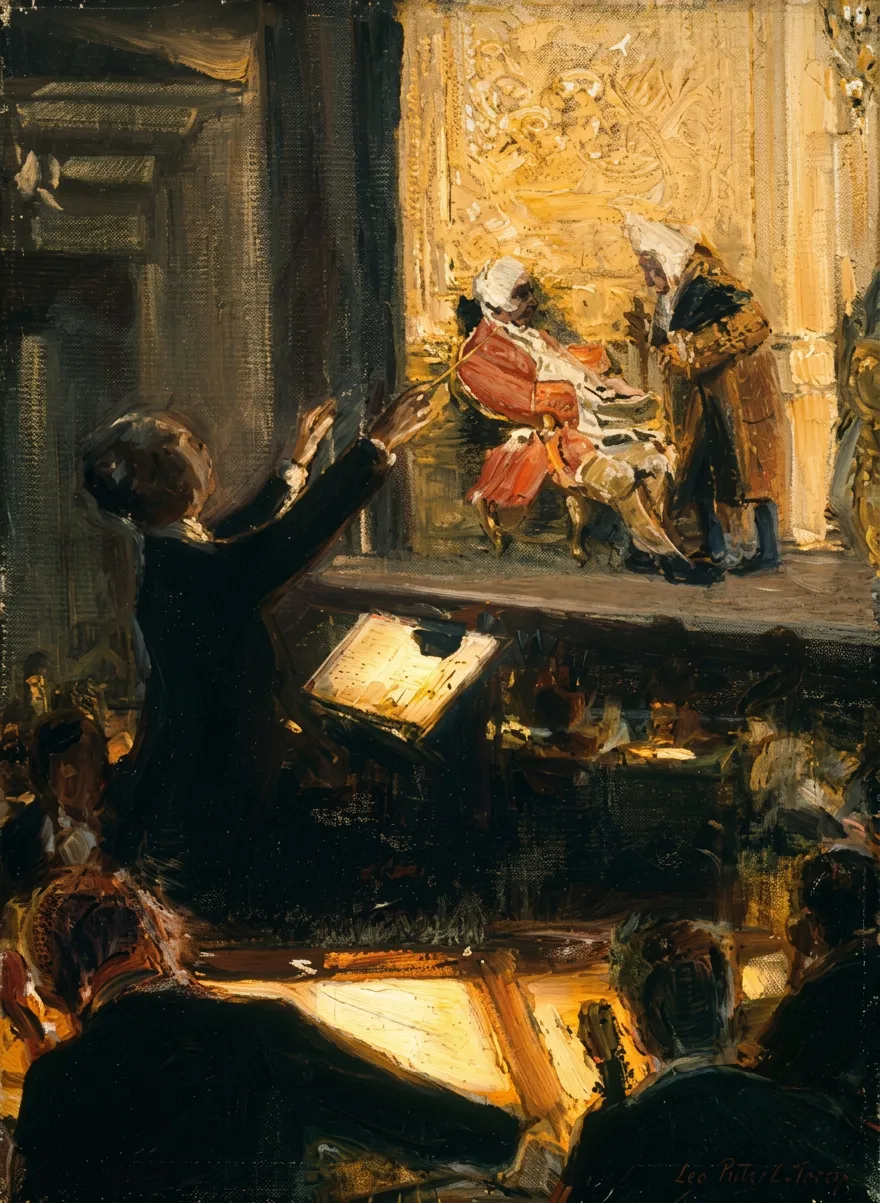
About the work
Richard Strauss's "comedy for music" in three acts, with a libretto by Hugo von Hofmannsthal, was premiered in 1911 at the Königliches Opernhaus in Dresden. Set in the Vienna of Empress Maria Theresia around 1740, the work marks Strauss's deliberate turn away from the violent modernism of Salome and Elektra toward lyrical nostalgia—though the score's harmonic daring fully equals those earlier works. The waltz-suffused music is itself a knowing anachronism that Strauss deployed with a wink.
Plot
The Marschallin, a beautiful aristocrat in her thirties, has taken the seventeen-year-old Octavian as her lover. Into this elegant affair bursts her cousin, the boorish Baron Ochs, seeking a cavalier to present a silver rose to his intended bride Sophie. Octavian, sent as the rose-bearer, falls in love with Sophie at first sight—and she with him. Through a comedy of intrigue involving cross-dressing, a staged assignation, and social humiliation, Ochs is exposed and gives up his claim. In the closing trio, the Marschallin releases her young lover with bittersweet grace, acknowledging that time runs on inexorably.
Cultural significance
Der Rosenkavalier stands among the great achievements of twentieth-century opera and is widely regarded as the finest collaboration between Strauss and Hofmannsthal. The final trio for Marschallin, Octavian, and Sophie is held to be one of the most exquisite ensembles in all opera. The Marschallin's Act I monologue on time and ageing is a touchstone for every dramatic soprano. The role of Octavian, written as a trouser role for mezzo-soprano, embodies Strauss's lifelong fascination with the female voice in all its registers.