About the work
Richard Wagner's three-act music drama with prologue is the Third Day and conclusion of Der Ring des Nibelungen, premiered at the first complete Ring at the Bayreuth Festspielhaus on 17 August 1876. At over four and a half hours, it is the longest Ring opera and one of the most ambitious works in all operatic literature, drawing the fifteen-hour cycle's threads into catastrophic resolution.
Plot
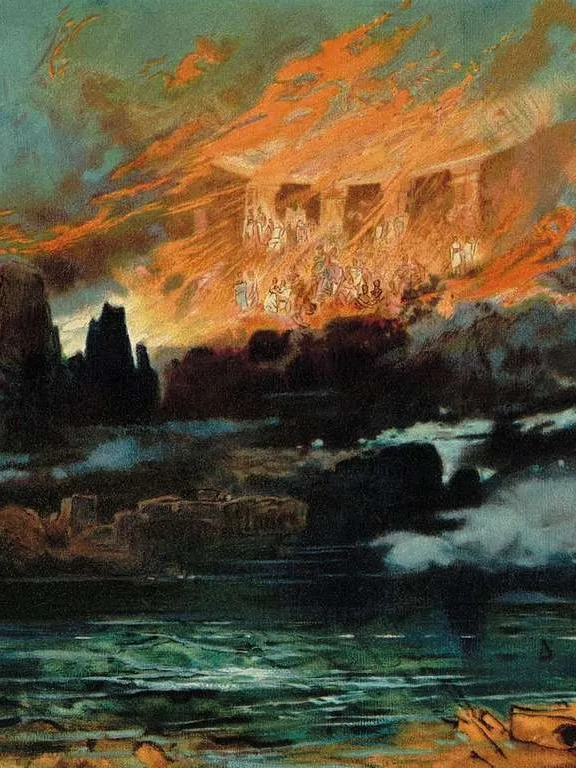
Siegfried, his memory altered by a magic potion given by the scheming Hagen, abandons Brünnhilde and betrothes himself to Gutrune, then steals the ring from Brünnhilde in the form of Gunther. Brünnhilde, enraged, reveals to Hagen how Siegfried can be killed. Hagen murders Siegfried during a hunt; his corpse is carried home in Wagner's overwhelming Funeral Music. Brünnhilde, recognising the truth, mounts her horse Grane and rides into Siegfried's funeral pyre. The Rhine overflows its banks; the Rhinemaidens reclaim the ring; Hagen drowns trying to take it; Valhalla burns; the world is renewed.
Cultural significance
Götterdämmerung completes one of the supreme artistic achievements of Western civilization and contains Wagner's most powerful orchestral writing: the Rhine Journey, Siegfried's Funeral Music, and the Immolation Scene—Brünnhilde's seventeen-minute closing monologue—are among the pinnacles of the operatic repertoire. The cycle's meaning has been endlessly debated, from Shaw's socialist reading (The Perfect Wagnerite) through Jungian myth criticism to the post-war German confrontation with the work's antisemitic shadows.