About the work
Richard Wagner's two-and-a-half-hour one-act opera is the prologue (Vorabend) to Der Ring des Nibelungen and was premiered on 22 September 1869 at the Königliches Hof- und Nationaltheater Munich under Franz Wüllner—Wagner himself, still in political exile, opposed the premiere but was overruled by King Ludwig II. The complete Ring cycle premiered at Bayreuth in 1876, for which Wagner built the festival theatre specifically.
Plot
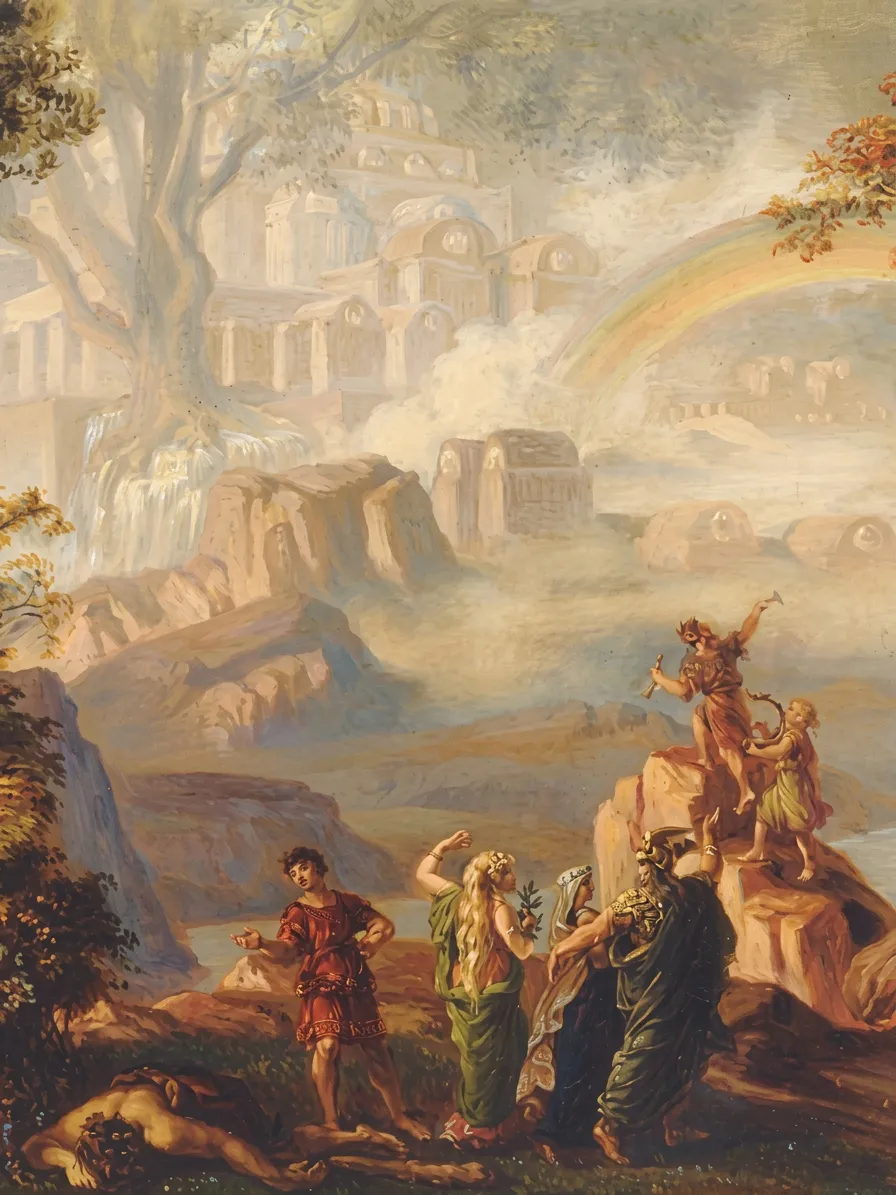
The dwarf Alberich steals the magical gold from the Rhinemaidens and forges it into a ring of absolute power, renouncing love as the price of the magic. The god Wotan, who has promised the giants Fasolt and Fafner the goddess Freia as payment for building Valhalla, seizes the Rhinegold and ring from Alberich to pay them instead. Alberich curses the ring: whoever wears it will be destroyed by jealousy and envy. The curse begins to work immediately—Fafner murders Fasolt to take the gold alone. The gods cross the rainbow bridge into their new fortress as the Rhinemaidens mourn their lost gold.
Cultural significance
Das Rheingold introduces the Ring's central musical and dramatic material: the Leitmotiv technique of musically labelling characters and concepts that Wagner developed to unprecedented complexity. The opera introduces over twenty Leitmotifs that will recur across the cycle. Wagner's setting of the opening chord of E-flat major, sustained for 136 measures as the river Rhine flows from nothingness, is one of the most hypnotic openings in Western music. Patrice Chéreau's centennial 1976 Bayreuth production reset the entire performance tradition.