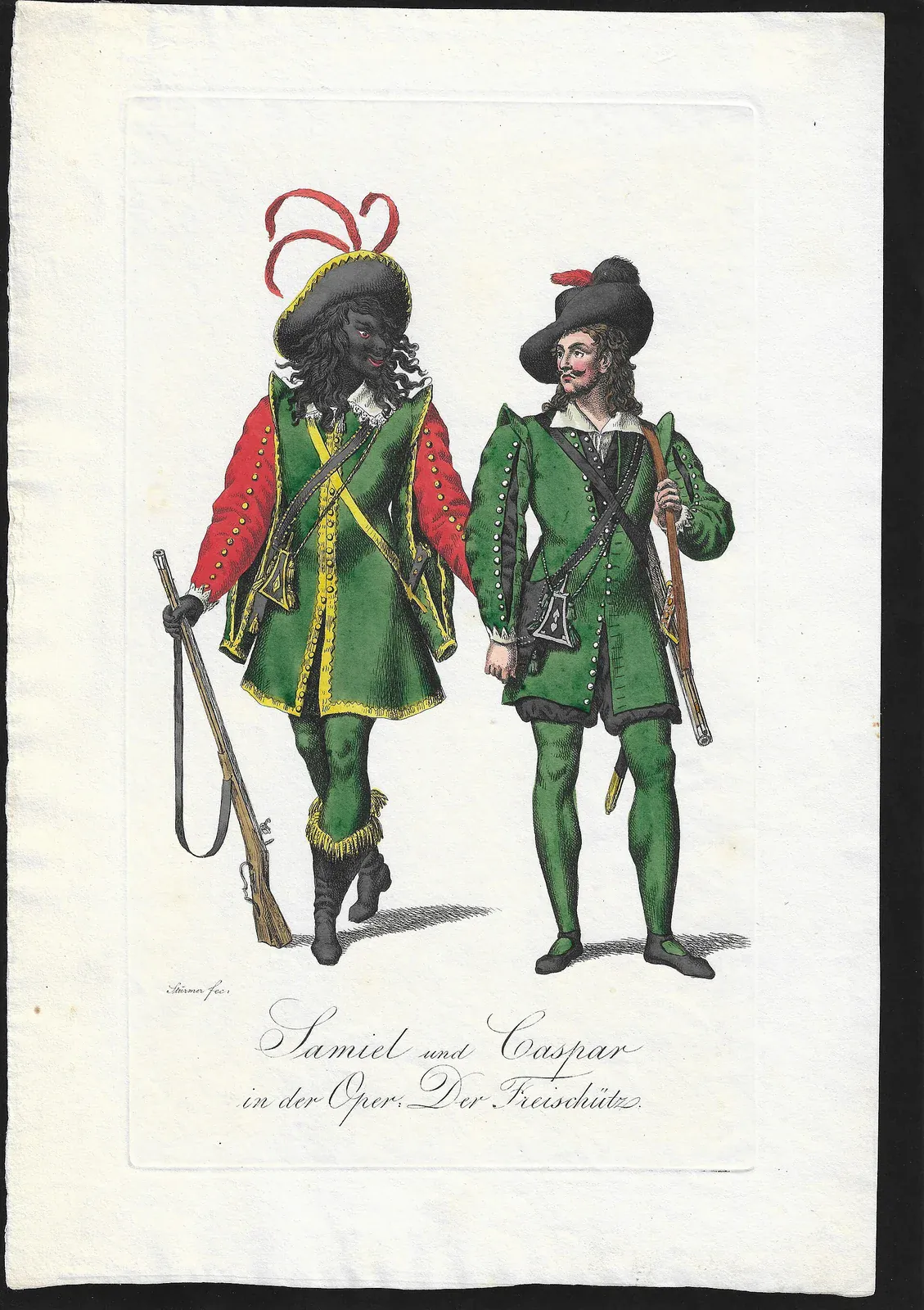
About the work
Carl Maria von Weber's three-act Romantic opera was premiered in 1821 at the Schauspielhaus am Gendarmenmarkt in Berlin, with a libretto by Friedrich Kind. The work is widely considered the founding masterpiece of German Romantic opera, establishing Weber as the direct predecessor of Wagner and defining a distinctly German alternative to the Italian operatic tradition.
Plot
The young hunter Max must win a shooting contest to marry his beloved Agathe, daughter of the head ranger. In despair at his failing skill, he turns to the dark huntsman Kaspar, who leads him to the terrifying Wolf's Glen at midnight. There, in a pact with the demon Samiel, they cast seven magic bullets—six that strike their mark, and one that serves Samiel's will. During the shooting contest, Max fires his last bullet at a white dove; it strikes Agathe, who falls as if dead. A hermit intervenes, revealing that Agathe was saved by her bridal wreath of sacred roses. Kaspar dies, having lost his soul to Samiel.
Cultural significance
Der Freischütz marked a turning point in European operatic history and established the German Romantic fascination with folk legend, nature mysticism, and demonic forces. The Wolf's Glen scene is one of the earliest and most vivid evocations of the supernatural in music, using offstage sounds, whispered recitation, and orchestral howling to unprecedented effect. The aria Leise, leise, fromme Weise and the Huntsmen's Chorus are among the most recognisable melodies in the German repertoire. Richard Wagner explicitly credited Weber as his primary precursor.