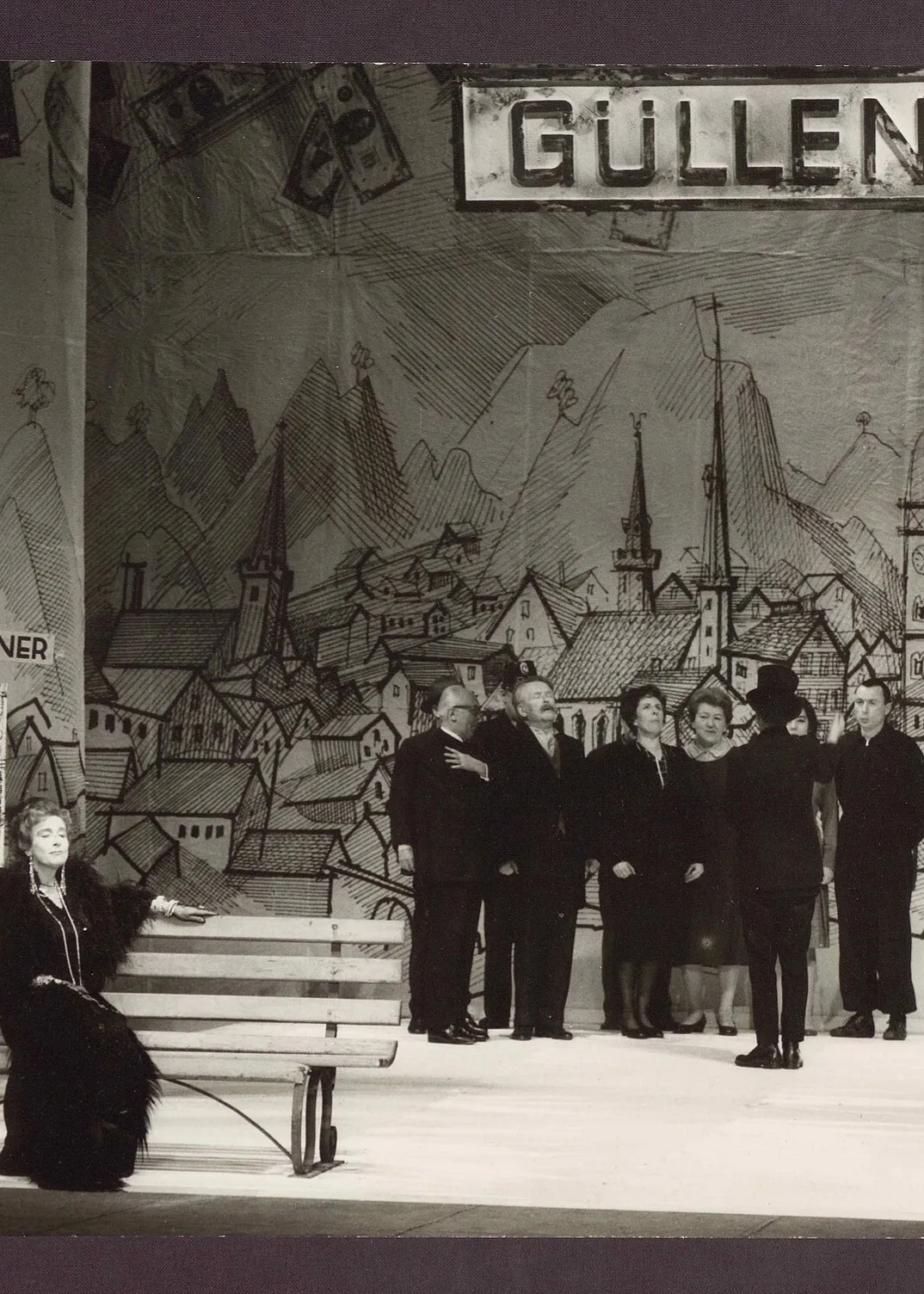
About the work
Friedrich Dürrenmatt's tragic comedy in three acts was premiered in Zurich in 1956 and is his most popular play and a major work of Swiss theatrical history. The work fuses grotesque comedy with moral tragedy and asks: how much money does it take for a community to resolve on murder?
Plot
To the impoverished provincial town of Güllen, Claire Zachanassian returns — the richest woman in the world, once driven out of the place as a young girl. She arrives with coffin, servants, eunuchs, tiger cage and a black panther. To the mayor she offers a billion — if the townspeople kill Alfred Ill, her childhood lover, who had once made her pregnant and disowned her with falsified witnesses in court (she had to go to Hamburg, became a prostitute, married into wealth). The townspeople indignantly reject the offer. But step by step they begin to buy on credit, new clothes, yellow shoes — Ill realises in horror: they will kill him, they just do not yet know it. In the third act the whole town gathers for the „democratic vote" — all vote for Ill's death, on moral grounds, „because he once did wrong". Ill, at the end of hope, accepts. The men close in on him in a side street — the murder happens behind closed doors. The doctor declares: „Death from joy." Claire takes the coffin away and leaves the money. The town celebrates its prosperity.
Cultural significance
The Visit is the most-performed Swiss drama and a key work of political allegory about material corruptibility. The play has been filmed several times (Bernhard Wicki's 1964 version with Ingrid Bergman and Anthony Quinn) and made into an opera by Gottfried von Einem (1971). Standard repertoire on German stages; productions by Frank Castorf, Andreas Kriegenburg and Frank Baumbauer are reference performances.