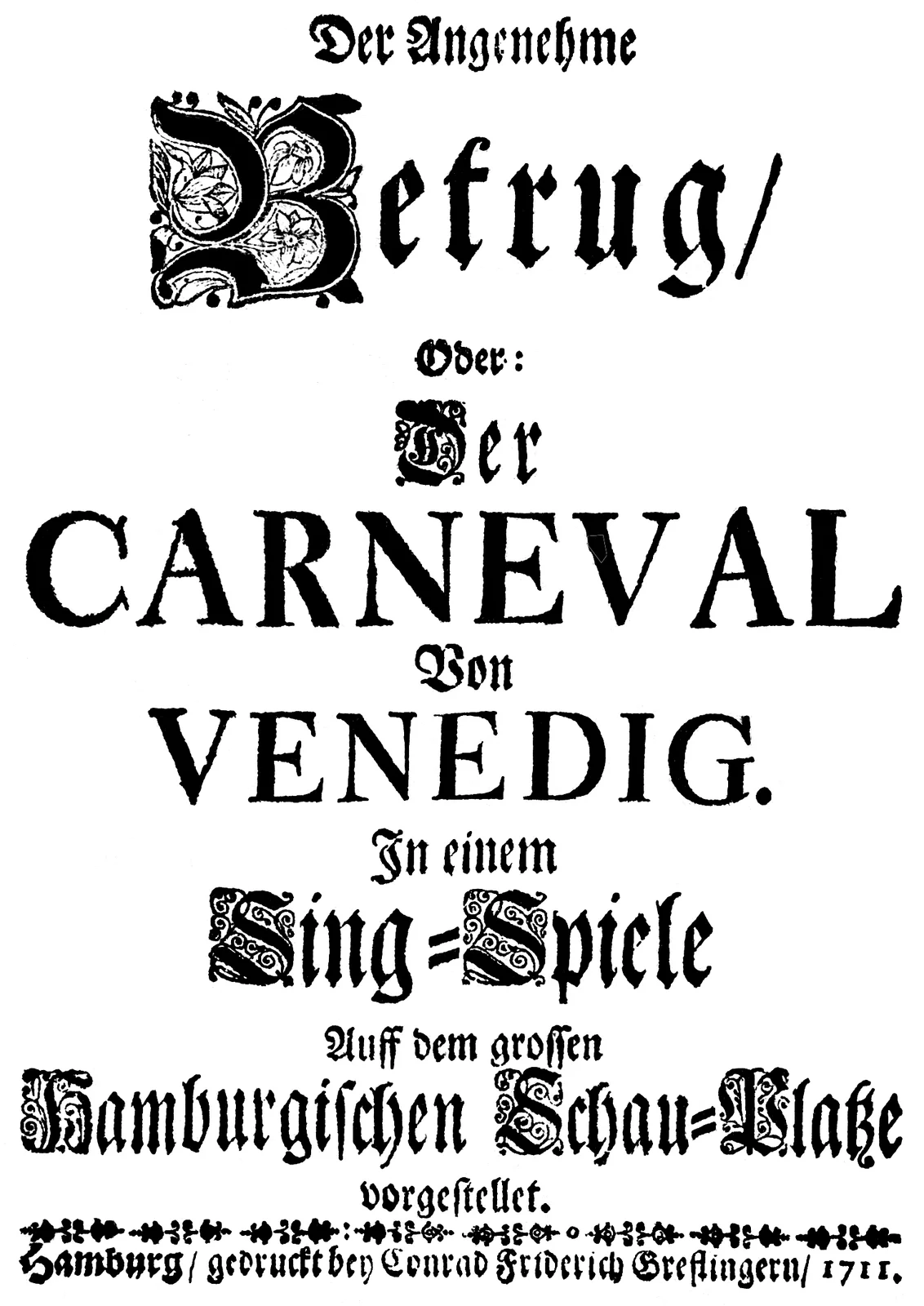
About the work
Baroque opera in three acts by Reinhard Keiser to a libretto by Johann August Meister and Mauritz Cuno, premiered in 1707 at the Oper am Gänsemarkt in Hamburg. The overture, recitatives and some choral scenes have not survived; modern productions such as those by Barockwerk Hamburg (2022/2023) fill the gaps as a pasticcio using music from other Keiser operas and from Georg Caspar Schürmann.
Plot
During carnival, two Venetian couples are kept apart by mistaken identities and faked deaths, until in the end Leonore is united with Leander and Isabella with Rudolffo. A German princess named Celinde, who rejects love altogether, eventually persuades her admirer Myrtenio to give up his courtship. Low German-speaking maids provide comic interludes with arias in that dialect.
Cultural significance
The work is one of the most linguistically varied operas of the Hamburg Gänsemarkt, mixing German, Italian, French and Low German text passages. One of its melodies survives to this day in the well-known German folk tune "Mein Hut, der hat drei Ecken", and the opera remained on the Hamburg stage unusually long, with revivals continuing until 1735.