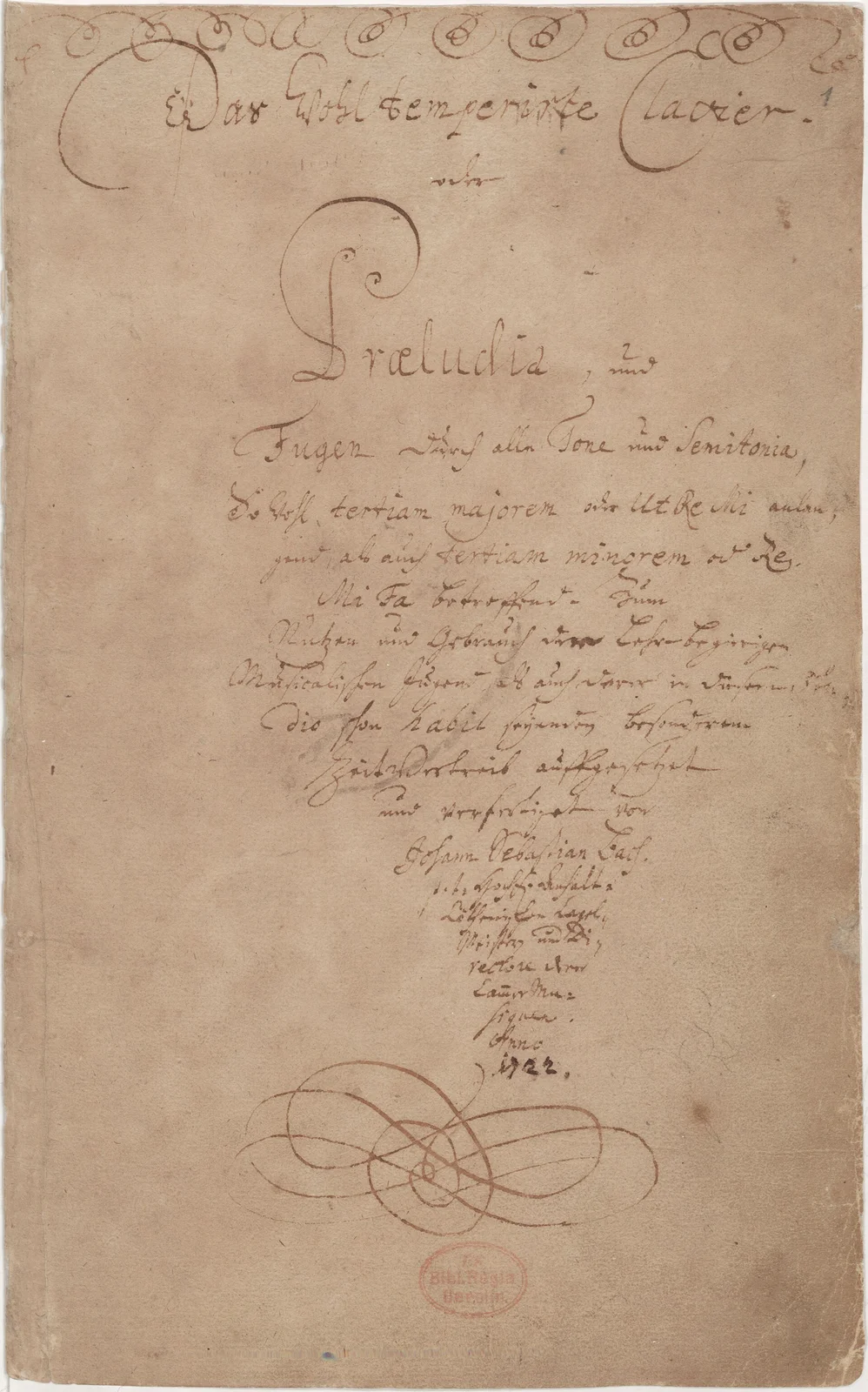
About the work
Johann Sebastian Bach's „Well-Tempered Clavier" (BWV 846-893) appeared in two volumes: the first in 1722 in Köthen, the second in 1740-44 in Leipzig. Each volume contains 24 preludes and fugues — one in each of the 12 major and 12 minor keys of the chromatic scale. The work is Bach's systematic demonstration of well-tempered tuning and is regarded as the „Old Testament" of piano music.
Plot
The two volumes — often cited as WTC I and WTC II — follow the same plan: 24 pairs of prelude and fugue, working through the chromatic scale (C major, C minor, C sharp major, C sharp minor, D major, D minor ...). The preludes are highly varied in style and form — from toccata-like openings through dances (allemandes, gigues) to meditative arioso pieces. The fugues range in number of voices from two to five and represent the whole contrapuntal vocabulary of Bach's age. Famous pieces: the celebrated C major prelude (later arranged by Charles Gounod as „Ave Maria"), the four-bar C sharp minor fugue (one of Bach's densest), the B flat minor fugue with its lamenting character, the E flat major prelude from Book II.
Cultural significance
The Well-Tempered Clavier is required repertoire for every pianist and organist and was placed by Hans von Bülow in 1801 alongside Beethoven's sonatas (the „New Testament") as the „Pianist's Bible". It influenced all later composers: Mozart studied Bach's fugues, Beethoven's „Eroica" Variations quote the WTC, Chopin's Preludes op. 28 are a direct response to the Bach model, Shostakovich's „24 Preludes and Fugues" op. 87 (1951) is the most important modern continuation. Famous recordings: Edwin Fischer (1933-36, the first complete recording), Glenn Gould, Sviatoslav Richter, Walter Gieseking, András Schiff, Daniel Barenboim.