About the work
Das Käthchen von Heilbronn, or The Trial by Fire, is a "grand historical romance of chivalry" by Heinrich von Kleist, premiered in 1810 in Vienna. The work combines medieval chivalric romance with dreamlike, somnambulistic elements and is among Kleist's most popular stage plays.
Plot
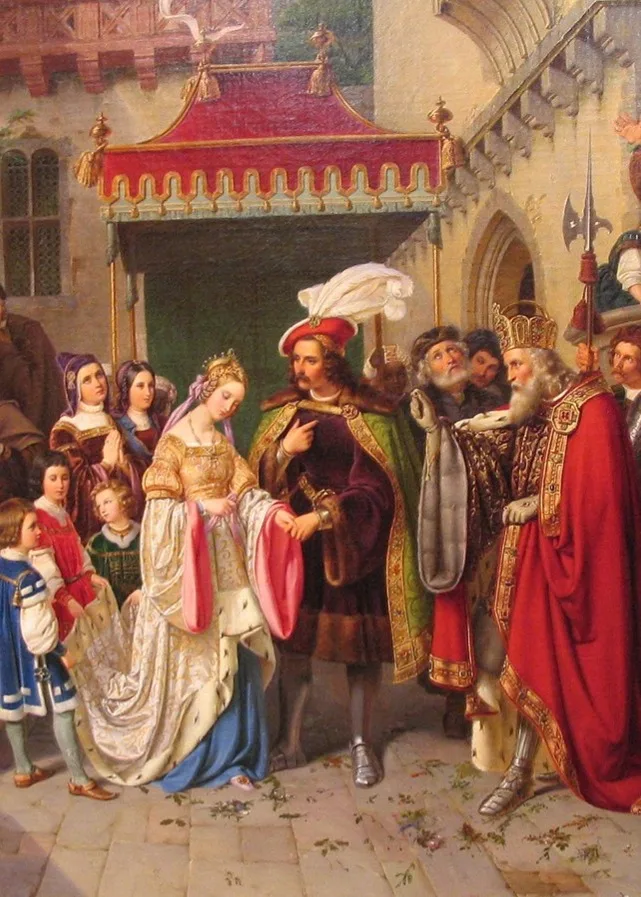
Käthchen, the young daughter of an armourer, follows Count Wetter vom Strahl with an enigmatic, unconditional devotion — she leaves her parents' home and trails after him as if in thrall, without any earthly explanation sufficing. The Count, at first irritated and dismissive, is in fact promised to the scheming Kunigunde von Thurneck, who hides her ugliness with false charms and magic arts. In the course of the play it is revealed that Käthchen and the Count had a shared dream-vision on the same New Year's Eve, which predestined their union. An angel and a cherub appear; finally it emerges that Käthchen is the illegitimate daughter of the Emperor — and thus the Count's equal. Kunigunde's deception is exposed, and Käthchen and the Count are united in marriage.
Cultural significance
Das Käthchen von Heilbronn combines Romantic dream-poetry with theatrical force and is one of Kleist's most-performed plays. The figure of Käthchen — pure, instinct-driven love as a counterpoint to the calculating Kunigunde — became the epitome of the Romantic female figure. The play inspired numerous adaptations and is regarded as a key work of German Romanticism on the stage.