About the work
Johann Wolfgang von Goethe's five-act tragedy was premiered in 1774 and is based on the autobiography of Pierre-Augustin Caron de Beaumarchais, who recounted his personal confrontation with the Spanish court official José Clavijo y Fajardo in his 1774 Mémoires contre Goezman. Goethe wrote the play in just eight days, transforming Beaumarchais's indictment into a tragic meditation on betrayal, ambition, and cowardice.
Plot
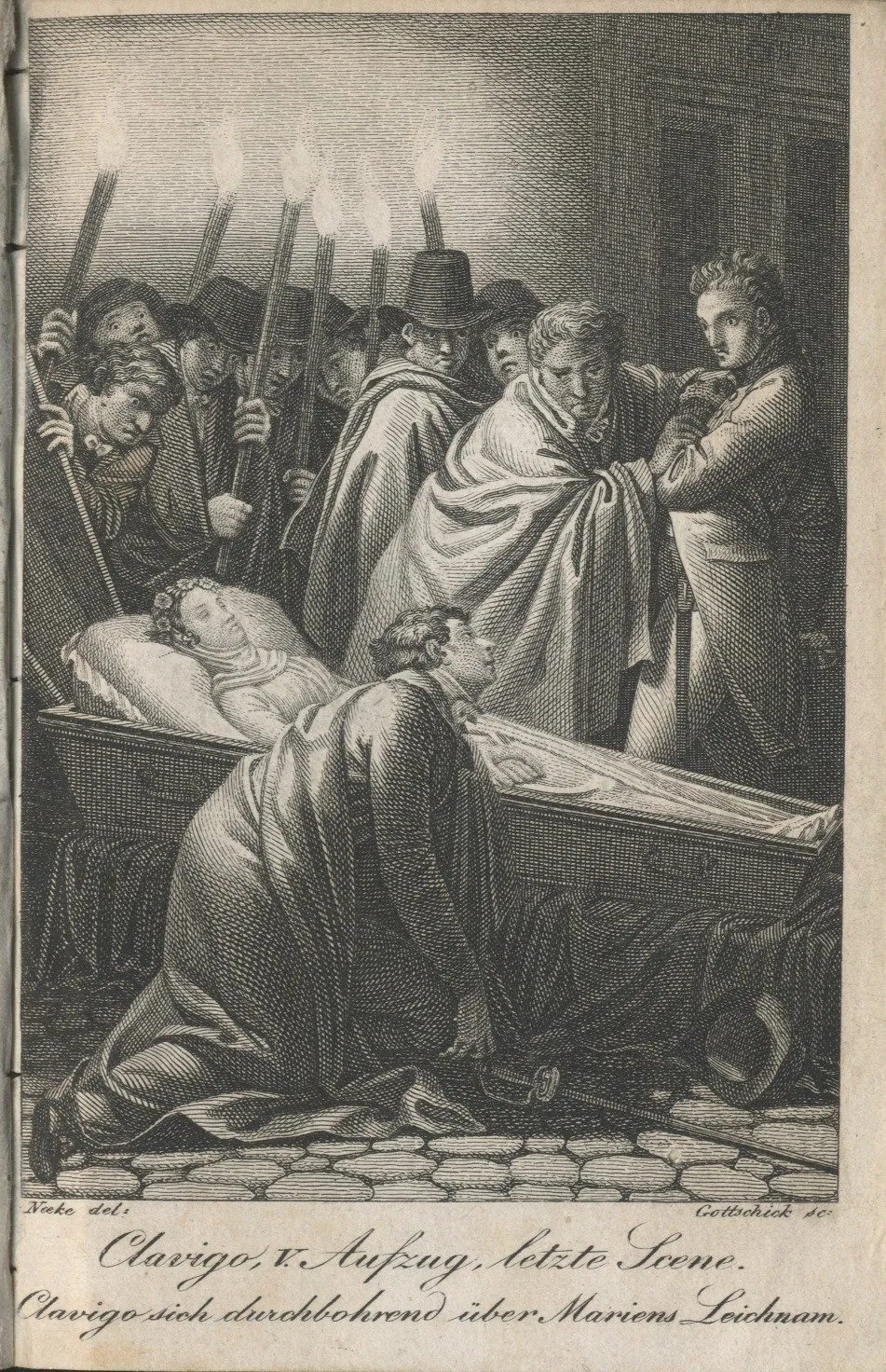
In Madrid, the career-ambitious writer Clavigo has abandoned his former lover Marie Beaumarchais for professional advancement. Her brother Pierre Beaumarchais arrives from France to demand justice. Clavigo initially promises reparation, but under the influence of his ambitious friend Carlos, he breaks his word again. Marie dies of grief. At her funeral procession Clavigo encounters Beaumarchais — they duel, and Clavigo dies on Marie's corpse.
Cultural significance
Clavigo is Goethe's only play featuring a real contemporary (Beaumarchais) as a dramatis persona, and it remains in the repertoire for the psychological sharpness of its central figure. Clavigo is an early prototype of the modern opportunist — neither villain nor hero, but a man who acts destructively out of pure weakness. Peter Stein's production at the Schaubühne in 1971 established the play in contemporary director-led theatre.