About the work
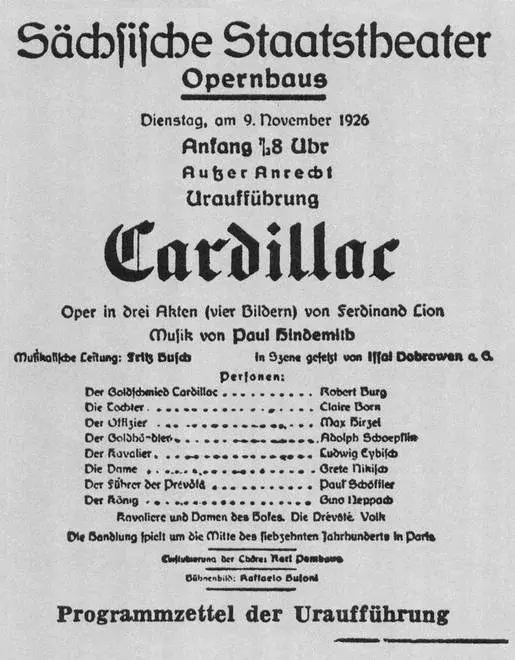
Cardillac is an opera in three acts by Paul Hindemith to a libretto by Ferdinand Lion, after E. T. A. Hoffmann's novella Das Fräulein von Scuderi. It was first performed on 9 November 1926 at the Sächsisches Staatstheater (Semperoper) in Dresden under Fritz Busch. Hindemith created a substantially revised version in 1952. Musically it fuses the sobriety of the New Objectivity (Neue Sachlichkeit) with Baroque formal models — a number opera with fugues and concerto movements — and ranks among the most important German operas of the 1920s.
Plot
In 17th-century Paris, the goldsmith Cardillac is celebrated for his exquisite jewellery. But he cannot bear to part with his creations: to reclaim them, he secretly murders the buyers. A series of mysterious killings grips the city in fear. As suspicion mounts and his daughter turns to an officer, Cardillac is finally exposed and killed by the enraged crowd — an artist driven to madness and death by his obsession with the perfection of his own work.
Cultural significance
Cardillac is regarded as a key work of New Objectivity in music theatre and as Hindemith's first full-length opera of stature. Its pairing of a detached, linear-contrapuntal idiom with a highly expressive subject — the creator's deadly obsession with his own work — has made it a much-discussed study of the relationship between artist and art. It remains in the international repertoire to this day.