About the work
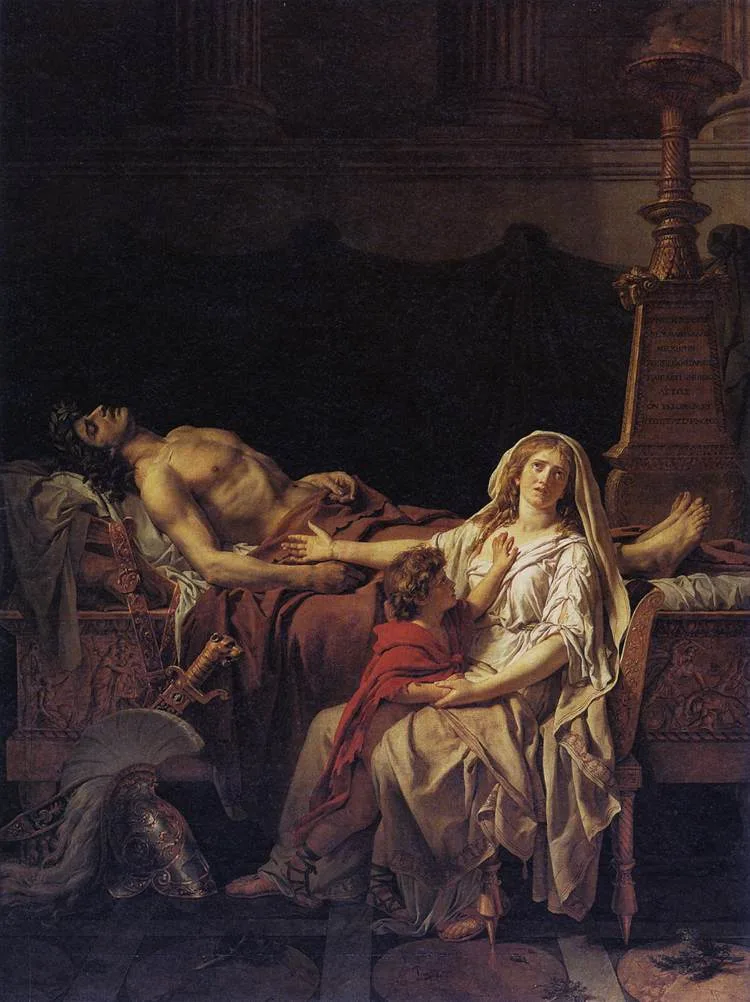
Jean Racine's „Andromaque" was premiered in Paris in 1667 — Racine's first great success and a key work of French Classicism. The play is a Trojan tragedy after Euripides and Virgil, in which the captive Andromaque (Hector's widow) forms the tragic centre of a love-quadrangle constellation.
Plot
Epirus, a year after the fall of Troy. King Pyrrhus (Achilles's son) holds the Trojan queen Andromaque and her son Astyanax as prisoners of war. Pyrrhus is engaged to Hermione (Helen's daughter) — but loves Andromaque. The Greeks send Orestes (Agamemnon's son) to demand the surrender of Astyanax — Orestes loves Hermione. Andromaque mourns Hector and wishes only to protect her son. Four people, four interlocking one-sided love constellations: Orestes loves Hermione, Hermione loves Pyrrhus, Pyrrhus loves Andromaque, Andromaque loves only the dead Hector. Pyrrhus offers Andromaque a choice: marry me, or I will hand over your son. Andromaque devises a plan — she will marry Pyrrhus at the altar to save Astyanax and then kill herself. Hermione, torn by jealousy, orders Orestes to kill Pyrrhus. Orestes has Pyrrhus murdered by his soldiers — Hermione, having forced this, screams at him that he has committed murder and kills herself. Orestes falls into madness. Andromaque reigns as queen of Epirus.
Cultural significance
Andromaque is one of the principal works of French Classicism and a defining model for tragedy after the Aristotelian unities (place, time, action). Racine's alexandrine verse — paired, iambic, twelve syllables per line — is required reading in French schools and shapes awareness of poetic form. Famous Hermiones: Sarah Bernhardt, Maria Casarès, Isabelle Adjani. Less performed in Germany; rarely on Anglophone stages. Stravinsky's ballet „Apollon musagète" arose in part as a response to Racine's French tragic tradition.