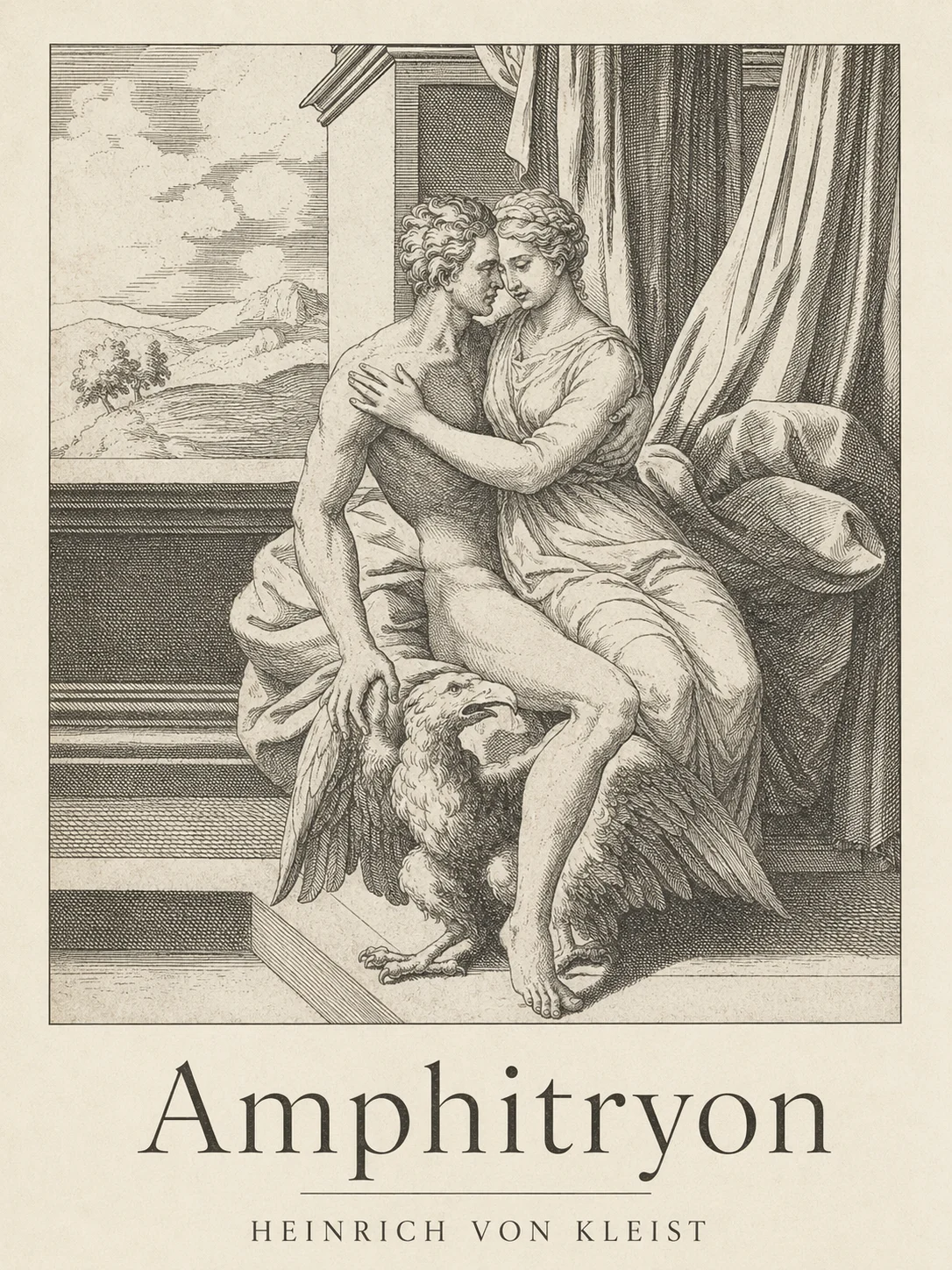
About the work
Heinrich von Kleist's verse comedy was published in 1807 and remained unperformed during his lifetime. The Berlin premiere finally took place in 1899 at the Neues Theater. The play reworks Molière's 1668 comedy of the same name, which in turn adapted Plautus, but Kleist deepens the classical material into a philosophical meditation on identity, trust, and the limits of human knowledge.
Plot
The Theban general Amphitryon returns from war and finds his wife Alkmene oddly changed. Unknown to either, Jupiter has spent a night with her in Amphitryon's form, while Mercury has impersonated Amphitryon's servant Sosias. When Amphitryon announces his homecoming, Alkmene denies she has been expecting him—she believes he has already arrived. The doubling of identities spirals through confrontations, humiliations, and moments of terrifying uncertainty. Alkmene is forced to doubt her own senses and the bond between her and her husband. Only when Jupiter reveals himself and announces that she will bear a half-divine son—Hercules—does the crisis resolve. Alkmene's final 'Ach!'—'Oh'—is one of the most famous wordless endings in German drama.
Cultural significance
Amphitryon is among Kleist's most philosophically searching works and a pinnacle of early German verse drama. Alkmene's closing exclamation has been subject to endless interpretation—as bliss, despair, metaphysical collapse, or all three at once. The play is a staple of German-language theatre and has drawn many celebrated Alkmenes, from Martha Eggerth through Elisabeth Flickenschildt to Andrea Sawatzki. The role requires exceptional capacity to communicate metaphysical vulnerability through the full transparency of Kleist's verse.