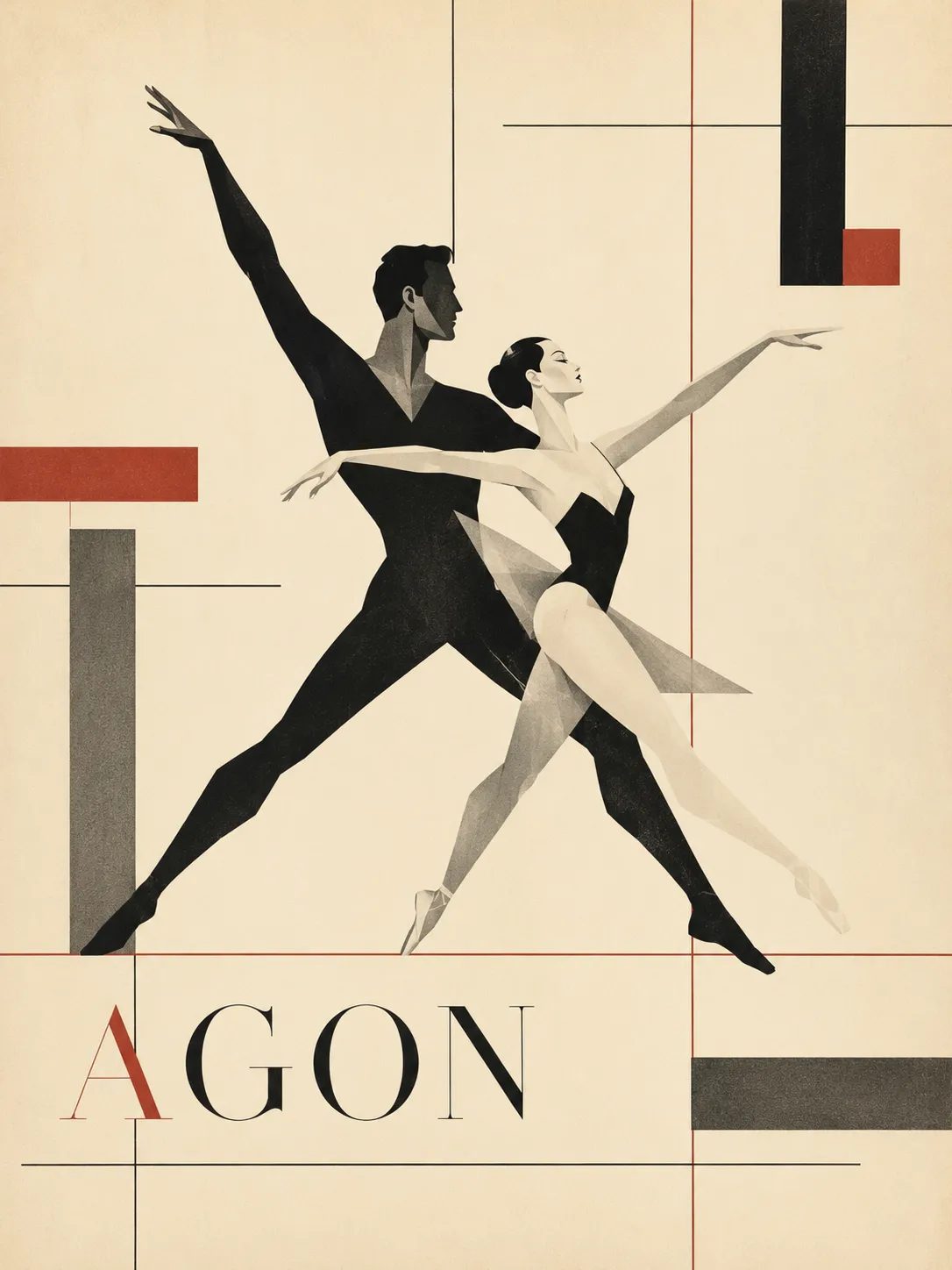
About the work
Agon is a plotless ballet by George Balanchine to Stravinsky's music of the same name, premiered in 1957 by New York City Ballet. It is the last and most radical of the three great Balanchine-Stravinsky collaborations and is regarded as a milestone of modern ballet.
Plot
The Greek title "Agon" means "contest," and that is exactly what the work is: an abstract danced competition for twelve dancers with no plot, costumes, or décor—only bodies in leotards against a plain background. In shifting formations, solos, duets, and ensembles, the dance responds precisely to Stravinsky's serial music, inspired by old French court dances. The central pas de deux, danced by a Black and a white dancer, forms the disturbingly beautiful core of the work.
Cultural significance
Agon revolutionised ballet by fusing classical technique with the rigour and dissonance of modernism—a work of breathtaking structural clarity. The mixed-race central pas de deux of 1957 was also a quiet, powerful statement in the era of the civil rights movement. Agon is regarded as a summit of Balanchine's neoclassical aesthetic and one of the most influential ballets of the twentieth century.