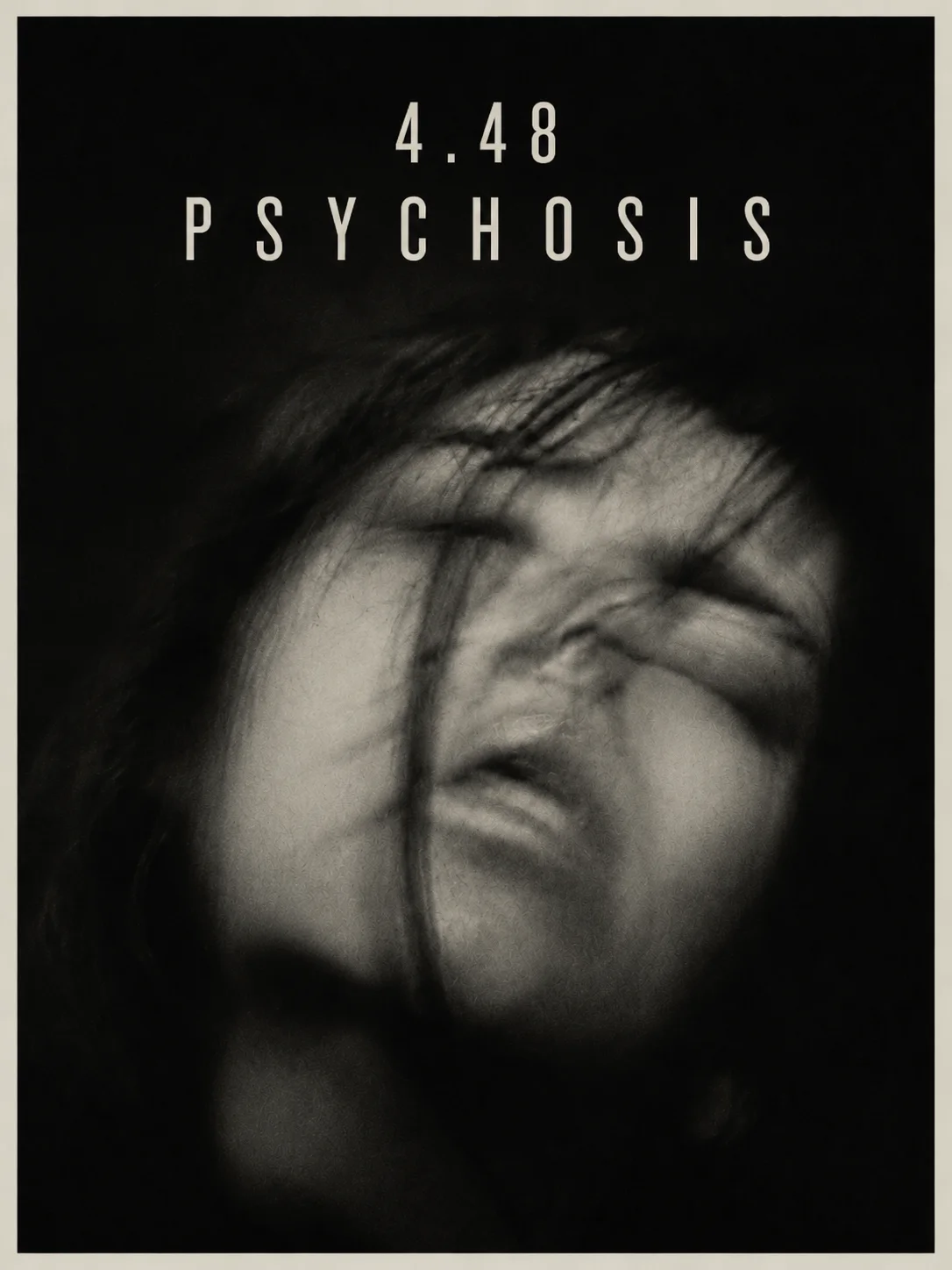
About the work
Sarah Kane's „4.48 Psychosis" was premiered posthumously at the Royal Court Theatre in London in 2000 — eighteen months after Kane's suicide in 1999. The play is Kane's last work and is regarded as one of the most intense texts of modern theatre on depression and suicidal ideation.
Plot
The play has NO conventional plot. No cast list. No clear assignment of voices. It is a literary collage of monologue fragments, dramatic dialogues, clinical lists, poetic sequences, mathematical calculations, cold reflections on suicide and religious despair. The stage is often filled with a single woman — the voice of a deeply depressed person at 4.48 a.m., „the hour at which clarity returns". She speaks to (with?) a therapist, a loved one, herself. There are lists of anti-depressants with their side effects, ironic assessments of clinical diagnoses, lyrical attempts at flight into love, repetitions of self-accusation. The play ends with „please open the curtains" — an instruction to a curtain-opener letting in the light, or to the theatre curtain ending the show. The piece is concerned with depression and suicide; if you yourself are struggling, support is available.
Cultural significance
4.48 Psychosis is one of the most important works of British „In-Yer-Face" theatre and Sarah Kane's legacy. The work is both honest self-testimony and a formal-literary experiment at the highest level — Kane herself took her life just over a year before the premiere (she died during the composition of the work). The question of whether the play is to be read biographically or fictionally is one of the most sensitive discussions in the canon. Productions by James Macdonald (premiere), Kane's brother Simon Kane, Ulrich Rasche and Stefan Pucher have firmly established the work in the repertoire. Required reading in British schools, a standard text in international theatre studies.