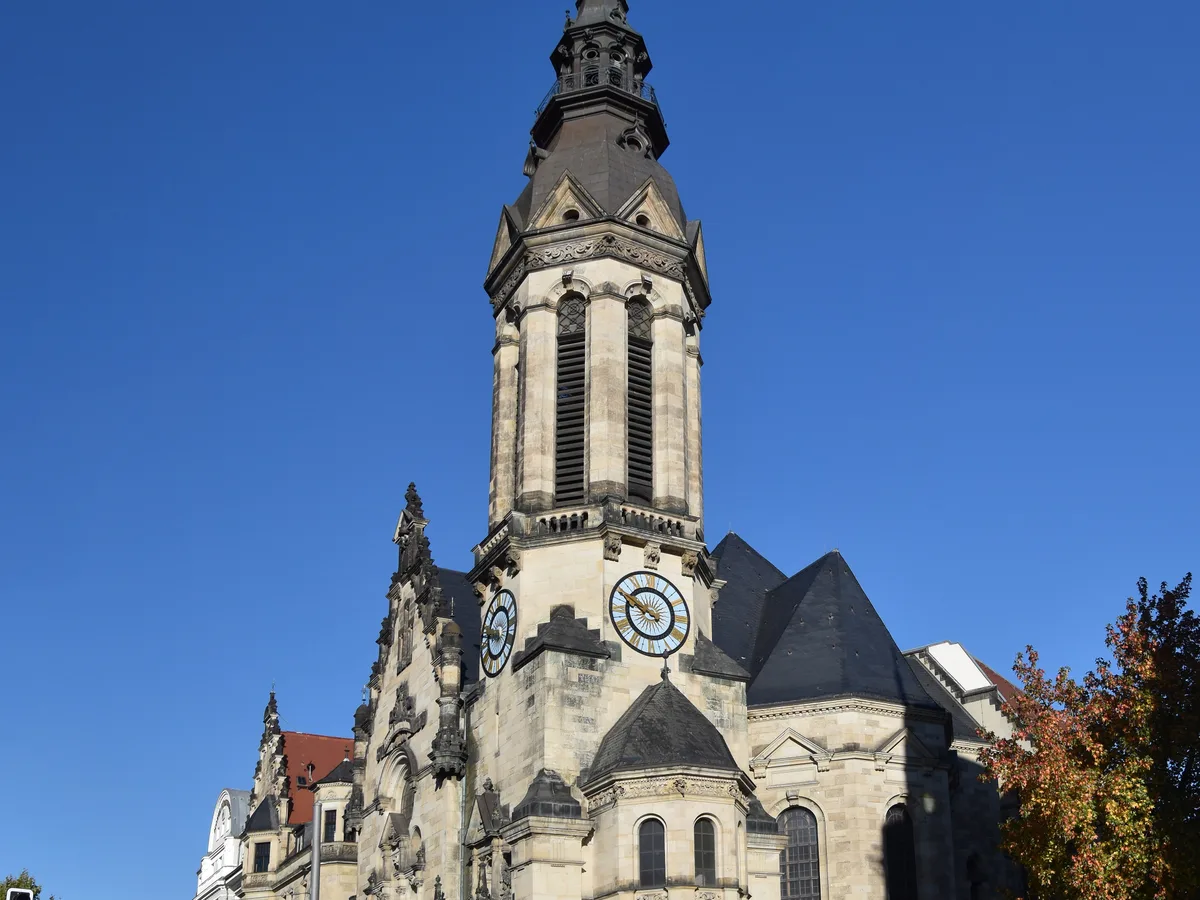
The Evangelical Reformed Church at Tröndlinring 7 is the place of worship of Leipzig's Reformed congregation, whose roots reach back to the Huguenot refugees who settled in the city from 1700. The present building was erected between 1896 and 1899 to designs by the Leipzig architects Georg Weidenbach and Richard Tschammer in the Neo-Renaissance style, and is regarded as the first sacred building of Historicism in Leipzig to draw deliberately on Renaissance forms. Church and adjoining parsonage form a unified parish complex — a then-novel concept whose design won first prize at the 1900 Paris World's Fair. The striking tower, about 73 metres high, still shapes the skyline of Leipzig's northern ring road; the interior seats around 700 and, with its stacked arrangement of communion table, pulpit and organ, follows the Reformed ideal of a preaching church centred on the Word. On the night of 4 December 1943 the church was severely damaged in an air raid; services resumed from 1950, a Jehmlich organ was installed in 1968, and the building was comprehensively restored between 1992 and 1996. Today the acoustically prized space also serves as a venue for sacred and chamber-music concerts.
In the autumn of 1989 the Reformed Church was the first place of worship in Leipzig after the Nikolaikirche to open its doors for the Monday peace prayers. On 9 October 1989 a film crew secretly recorded the peacefully demonstrating crowds from the church tower — footage that travelled the world as a document of the Peaceful Revolution.